
Search Oregon Traffic Court Records
Read the court name on the citation first. Oregon traffic violations may be filed in Circuit Court, a county justice court, or a city municipal court. Parking can use a city bureau or local system. For an OJD circuit matter, search the OJD Courts ePay service by court case number or citation, summons, or complaint number. The portal handles eligible OJD circuit cases. It explicitly excludes municipal and justice court cases.
The official OJD ePay page shows the scope and number formats used for Oregon circuit citation records.
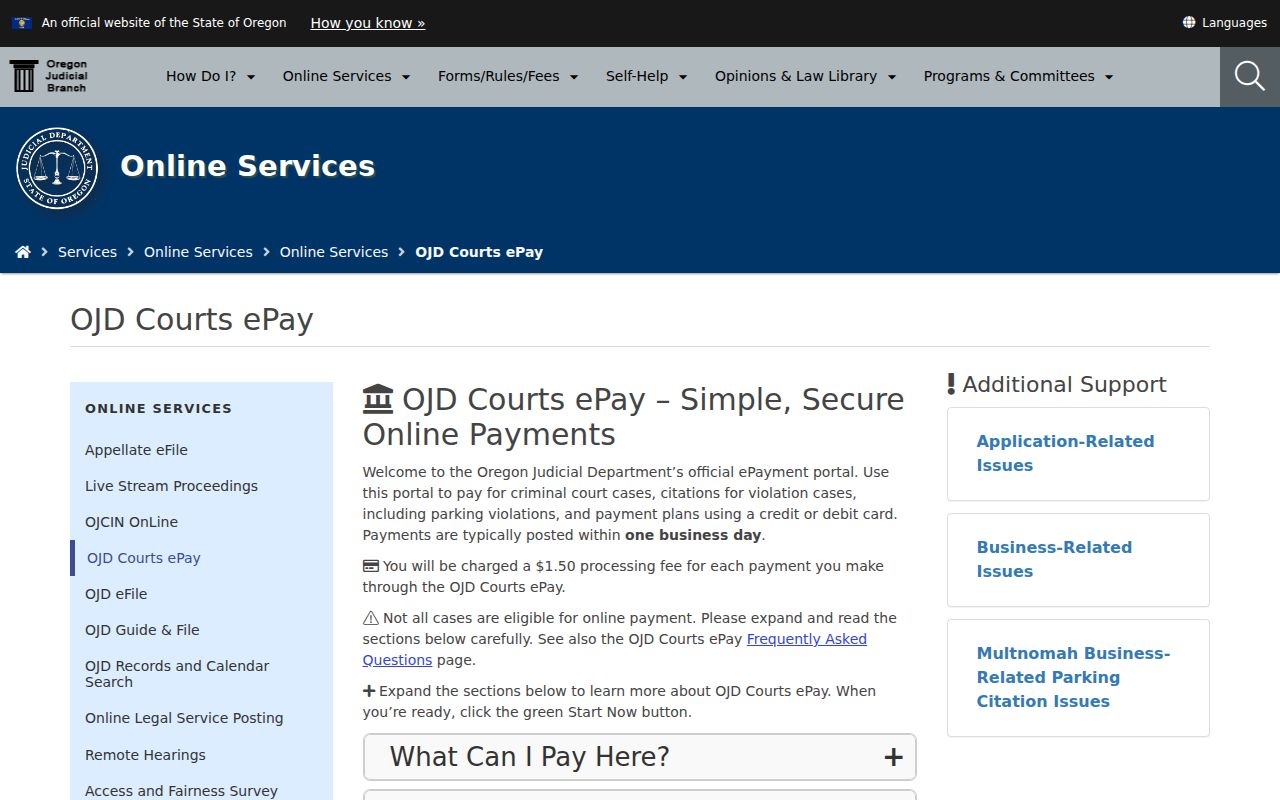
When the cited court is local, use its official clerk and payment channel rather than OJD support.
| Field or Control | Type | Required | Oregon Use |
|---|---|---|---|
| Search Type | Radio or tab | Yes | Select court case or citation, summons, or complaint |
| Court Case Number | Text | Alternative | Examples include VI, PK, and CR formats; OJD cases do not begin “SP” |
| Citation Number | Text | Alternative | Copy every letter and number, including a parking prefix |
| Name or Verification | Text | Conditional | Match the payer or case as the portal asks |
| Amount and Card | Payment | To pay | Visa, Mastercard, Discover, or American Express |
Note: OJD ePay is an Oregon circuit tool; send municipal and justice court pleas, payments, and copy requests to the cited local clerk.
Locate the Oregon Traffic Court
Circuit courts handle state-law violations and traffic crimes filed within OJD. County justice courts and city municipal courts operate outside the state-funded OJD case and payment system. The citation controls the first route. A city ticket does not become an OJD matter merely because the event occurred in Oregon, and an OJD search failure does not cancel a local citation.
DUII, reckless driving, and driving while suspended can be crimes rather than simple payable violations. A single stop can produce both a violation and a separately numbered criminal charge. Parking and photo enforcement may use a municipal or administrative channel. Open the Oregon county directory for the circuit or justice route, then follow the cited city's official site for a municipal case. Residence is not venue.
Note: Obtain the written judgment and published appeal information promptly because the route depends on the tribunal and whether it is a court of record.
Read Oregon Traffic Court Records
The roadside citation begins the allegation. Later court entries control amended charges and judgment. A citation can state the issuing agency and officer, alleged event date and location, vehicle, statute or ordinance, violation or crime label, printed fine, cited court, response date, appearance choices, and special crash, work-zone, school-zone, photo, or CDL facts. Public copies may omit a full driver license number, birth date, home address, and protected insurance or medical details.
- Case and citation numbers
- The local or OJD identifier and original law-enforcement number.
- Charge and class
- The statute or ordinance, description, and violation or criminal level.
- Dates and events
- Incident, filing, response deadline, hearing, trial, and officer or witness appearance.
- Plea and disposition
- Not guilty, no contest, or guilty response plus conviction, dismissal, or other finding.
- Financial status
- Fine, assessment, payment plan, balance, collection, or default events.
- Consequences
- Failure to appear, warrant, DMV notice, and appeal entries when applicable.
Evidence may sit outside the docket. Officer notes, body or dash video, calibration certificates, photo-radar images, dispatch records, crash reports, and tow records may belong to the prosecutor or issuing agency. The clerk produces only material filed with the court. Oregon DMV's separate police crash report product does not prove that each exhibit was filed in the case.
Note: Request Oregon traffic evidence from its actual custodian because a court docket lists events but may not contain every police exhibit.
Pay or Contest Oregon Tickets
An Oregon circuit citation can take up to 15 days to appear in ePay, while Multnomah parking can require at least 48 hours. Search with the full citation number first. After OJD assigns a VI, CR, or PK number, keep both numbers for later requests. No immediate result during that entry window does not mean dismissal.
- Read the cited court, number, violation or crime label, response date, and any required appearance.
- For an eligible circuit violation, wait for entry and search OJD ePay.
- Before paying an open violation, understand that payment enters a no-contest plea, waives trial, and permits a guilty finding.
- To contest, follow the citation's not-guilty instructions by the deadline and do not pay online.
- For a municipal or justice ticket, send the plea or payment only to that official local court.
- After resolution, keep the judgment, receipt, and proof of compliance, then verify any separate DMV action.
OJD ePay cannot submit a trial request, letter of explanation, or not-guilty plea. Ask the cited clerk about mail, counter, remote appearance, interpreter, accommodation, discovery, payment plan, ability-to-pay review, or any lawful course or diversion option. Eligibility depends on the charge, court, and driving history. Oregon does not support a blanket promise that “defensive driving” dismisses every ticket.
Order an Oregon DMV Record
Oregon Driver & Motor Vehicle Services maintains driver records, not court pleadings. Owners can order their own record through DMV2U. Requests for another person's protected data require a qualifying use under ORS 802.175 through 802.191, the appropriate form, identity details, certification, and payment. Employers, insurers, government agencies, litigants, consented users, and owners may qualify in distinct settings. A small fee does not turn DMV into an unrestricted people-search database.
The Oregon DMV records hub directs drivers to DMV2U and the state's official request methods.
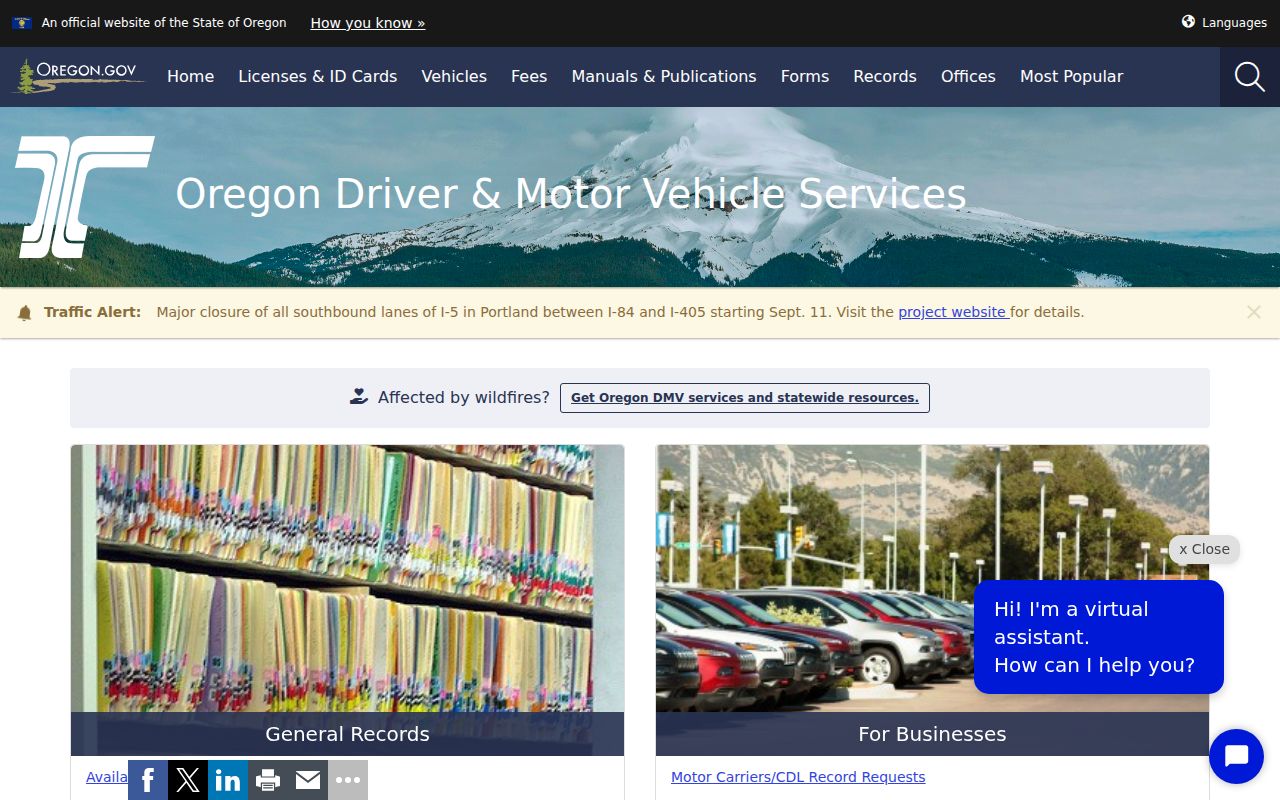
Choose the product by purpose because each Oregon driver record has a different time span and content.
Note: DMV2U serves an Oregon driver's own record, while another-person data requires the proper qualification, form, certification, and payment.
Choose an Oregon Driver Record
The detailed Oregon DMV record inventory identifies current products, qualifications, content, and fees.
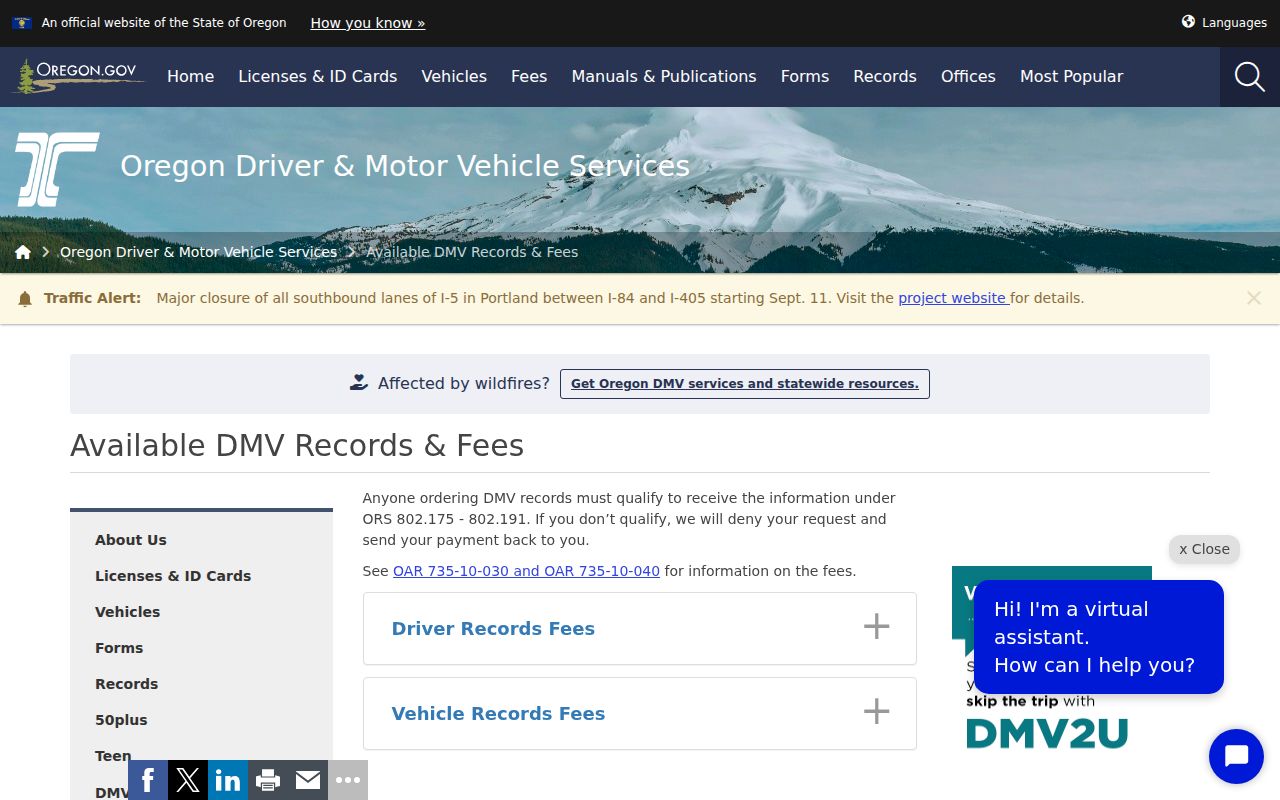
For a request, provide the requester name, address and contact details, subject name and birth date, Oregon customer number if known, desired product, relevant incident or period, lawful-use qualification, required authorization, signature, and payment. A Certified Court Print combines ten years of major traffic convictions and listed CDL, diversion, and alcohol-rehabilitation entries with five years of minor convictions, accidents, suspensions, cancellations, and revocations. Despite its name, it remains a DMV record prepared for court use.
Oregon Court File Versus Driver Record
A court conviction flows from the circuit or local clerk to DMV, where it is posted under the driver-record rules. The two systems may update at different times. If a transmitted disposition is wrong, begin with the court for correction and retransmission. If DMV indexed an accurate judgment incorrectly, use the DMV correction process with the certified judgment. A court clerk cannot issue a DMV Certified Court Print, and DMV cannot certify the court pleadings.
| Question | Oregon Court Traffic File | Oregon DMV Record |
|---|---|---|
| Custodian | Circuit, municipal, or justice clerk | ODOT Driver & Motor Vehicle Services |
| Main identifier | Citation and court case number | Driver license or customer identity |
| Shows | Charge, plea, hearings, judgment, fine, and warrant or default events | Product-specific convictions, diversion, crashes, status, and suspension data |
| Access | OJD portal or cited local court | DMV2U own record or qualified request |
| Correction | Ask the filing clerk to correct the docket or disposition | Submit proof to DMV when its indexing is wrong |
Oregon does not use a simple public points score that should be invented or copied from another state. DMV Driver Improvement evaluates qualifying convictions and preventable collisions under current program rules. Report the actual status and entries shown on the selected product.
Access Limits on Oregon Traffic Records
Public court access and DMV privacy follow different rules. Oregon court files are maintained under court-record statutes, rules, and judicial authority. The Oregon Public Records Law governs many executive and local agency records, but it does not force a court to disclose protected material. Driver data is restricted by the federal Driver's Privacy Protection Act and Oregon's permissible-purpose statutes. A requester must use the record only for the certified lawful purpose.
Key distinction: Court access reveals the public case; DMV access requires the right product, identity match, fee, and lawful basis for protected driver data.
Sealed cases, protected identifiers, juvenile material, medical facts, and other confidential content remain restricted. An Oregon set-aside also does not guarantee removal of every lawfully retained DMV entry. Ordinary traffic convictions are not automatically sealed, and current eligibility turns on the offense and ORS 137.225. Oregon court guidance states DUII cannot be set aside, including a dismissed diversion.
Oregon Traffic Record Fees
Oregon court-copy fees depend on the item and court service, so use the official OJD fee resources or ask the local clerk for a quote. DMV products have fixed published prices. The selection below shows the statewide amounts supported by Oregon DMV research.
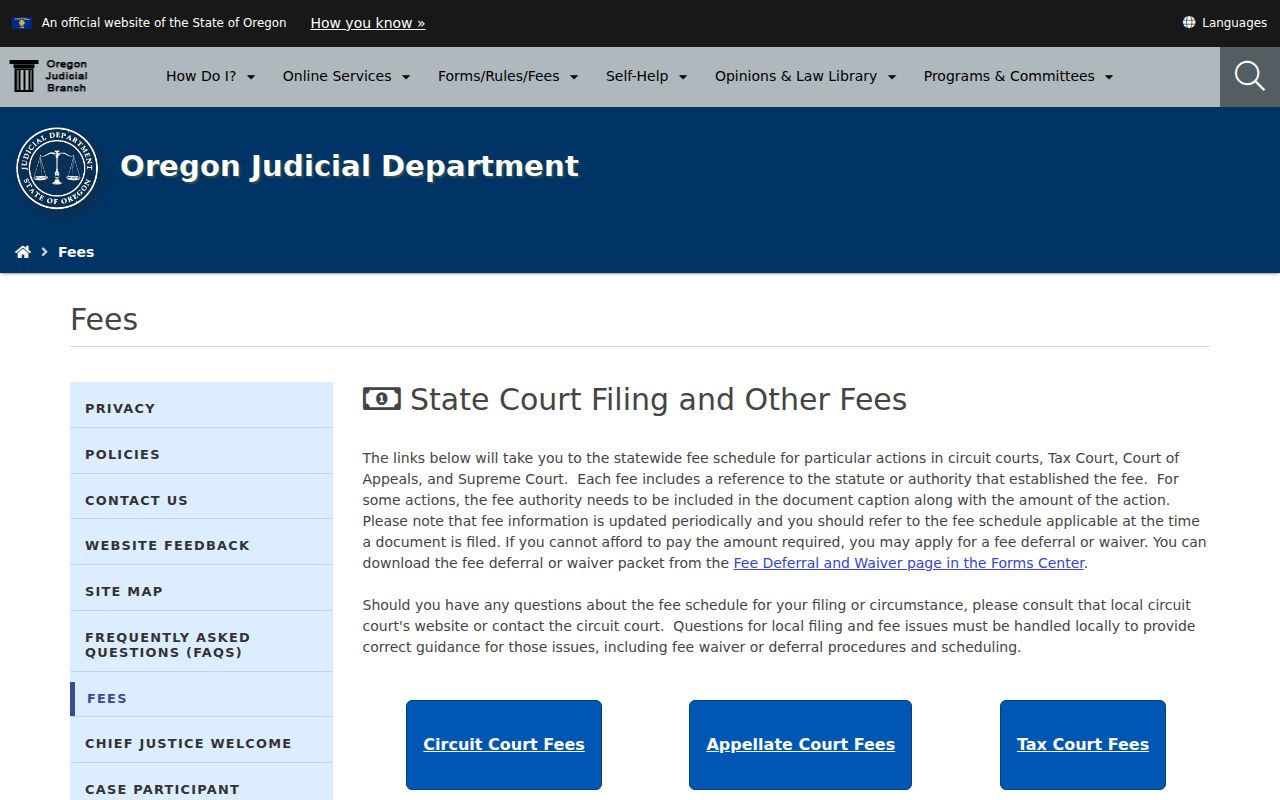
The court fee source should be checked before ordering because the desired citation, judgment, certification, audio, or mailing service changes the total.
| Record Product | Amount |
|---|---|
| Electronic public court document | $3 per request in a case; electronic delivery $0 |
| Paper court copy | Commonly $3 per request plus $0.25 per page; court quote controls |
| Certified court copy | $5 plus $0.25 per page |
| Three-year non-employment certified DMV record | $1.50 |
| Three-year employment certified DMV record | $2, or $1.50 if no record |
| Certified Court Print | $3, or $1.50 if no record |
| Court Print with CDL Medical Certification | $3 |
| Suspension Package | $11.50 |
| Police traffic crash report | $8.50 |
| Driver license or ID application history | $17.50 |
Oregon DUII and CDL Records
A traffic violation carries no incarceration and follows violation procedure. A misdemeanor or felony traffic crime brings criminal arraignment, possible right to counsel, discovery, pleas, and sentencing. DUII diversion is a specific Oregon court program with its own eligibility and conditions, not generic traffic school. Paying a payable violation does not resolve a separately numbered criminal charge. For the arrest-to-filing path, use the Oregon arrest and charge records resource.
CDL consequences can arise from designated conduct in a personal vehicle as well as a commercial vehicle. Oregon DMV states that two serious offenses within three years can result in a 60-day suspension and three or more can result in 120 days under the cited rules. Diversion and failure-to-appear reporting can also carry commercial consequences. Do not assume ordinary deferral options will prevent federal or state CDL reporting.
Note: A payable Oregon violation and a separately numbered criminal traffic charge must each be resolved through the court that holds it.
Oregon Diversion and Record Relief
Oregon does not provide one statewide “deferred adjudication” or defensive-driving dismissal for all traffic cases. A court may publish a fine reduction, payment plan, traffic safety course, diversion, or other option tied to the charge and driving history. Ask the cited clerk what is actually available before entering a plea. Successful completion can affect the court disposition, but DMV reporting follows the law and the specific program rather than a general promise that no entry will appear.
Sealing and set-aside rules are also offense-specific. ORS 137.225 excludes or limits categories, and ordinary traffic convictions are not erased automatically. Oregon court guidance says DUII cannot be set aside, including when diversion ended in dismissal. Even when a court record qualifies for relief, DMV may retain an entry that separate law requires it to keep. Obtain the order, then review the selected DMV product instead of assuming both systems changed at once.
Find Oregon Traffic Records Locally
For a circuit or justice citation, use the Oregon county directory to reach the county tied to the cited court. For a municipal citation, identify the city and use its official court. Request the citation, register, judgment, payment record, or certified copy from that clerk. Seek discovery or public records from the prosecutor or issuing agency when the desired evidence was never filed with the court.
After judgment, order the appropriate Oregon DMV product separately if license status or reported driving history matters. Compare it with the certified judgment. Address court default, warrants, collections, license suspension, reinstatement, and CDL duties with their respective custodians. A payment to DMV does not change a conviction, and a court payment does not by itself prove restored driving privileges.
Note: Keep both the original citation number and assigned court number because Oregon entry, payment, copy, and DMV channels may use different identifiers.