
Oregon Arrest Records and Charges
Oregon arrest records identify the custody event created by police or a sheriff. A jail booking can add a booking number, photograph, fingerprints, arresting agency, initial suspected offenses, holds, release information, and intake data. Those labels are preliminary. The county district attorney or an authorized city prosecutor reviews the reports and may decline filing, seek more investigation, or charge different counts. An officer's arrest description does not bind the prosecutor.
Court charges after arrest begin with a complaint, information, or indictment filed with a clerk. OJD circuit clerks maintain circuit charge records under each Trial Court Administrator. Municipal and justice clerks keep their local cases. Booking and custody details remain with the jail, so use Oregon inmate records for that separate system. The court register then tracks arraignment, pleas, amendments, motions, disposition, and judgment.
Find Oregon Arrest Records
There is no single public Oregon mugshot or booking database promised by this search. Start with the arresting county's sheriff or police records unit for a current booking sheet, releasable arrest report, incident number, or probable-cause material. Then search the free OJD Records and Calendar Search for charges actually filed in circuit court. A local municipal or justice matter needs that court's clerk.
- Identify the county of arrest, arresting agency, approximate date, and booking or report number.
- Check the county jail roster or request the releasable booking record.
- Search OJD by defendant name or CR case number for circuit charges.
- Open the case and read every count's statute, class, amendment, and disposition.
- Order the charging document or judgment from the filing clerk when exact wording matters.
If venue differs from residence, follow the filed case, not the person's home. A booking hold may come from another county or agency and is not necessarily a new charge. The Oregon county directory routes to circuit courts and local sources. Ask the police or sheriff for electronic delivery and a cost estimate when using a public-record request.
A narrow agency request can seek a booking sheet, arrest report, incident number, and probable-cause affidavit if releasable. Include the name, approximate arrest date and place, and report or booking number. Active-investigation, victim, medical, and exempt security content may be withheld. A court-filed probable-cause document or charging instrument still comes from the clerk.
Oregon Charging Documents
A charging document identifies the Oregon court, defendant, counts, statute or ordinance, alleged date, and factual accusation. A complaint can initiate designated proceedings. A prosecutor may use an information where Oregon law permits, including felony prosecution after waiver of indictment. An indictment follows a secret grand-jury proceeding. A “true bill” means the grand jury found grounds to accuse, not that the person is guilty.
| Complaint | Information | Indictment | |
|---|---|---|---|
| Source | Sworn or formal accusation | Prosecutor-filed instrument | Grand jury accusation |
| Oregon use | Can initiate designated criminal proceedings | Used where law permits, including after waiver of indictment | Common felony route after a true bill |
| Meaning | Accusation | Accusation | Probable-cause accusation, not conviction |
The clerk assigns a CR number and records each count. Arraignment then addresses rights, counsel, release, plea, and dates. Amendments may change the statute, wording, level, or count list. A dismissal may occur on prosecutor or court motion and may be with or without prejudice.
Oregon Court Charge Status
Read status per count. An overall closed label can hide different outcomes. Oregon records may show pending, open, amended, superseded, dismissed, merged, guilty, no contest, acquitted, diversion, transferred, closed, or set aside. Police and prosecutor systems can instead say referred, received, under review, declined, issued, no complaint, or returned for follow-up. Those are not universal OJD codes.
- Pending
- The count remains unresolved and is not proof of guilt.
- Amended or superseded
- Later wording, statute, class, or instrument replaced an earlier form.
- Dismissed
- The count ended without a conviction on that count.
- Merged
- The count was combined for judgment or sentencing as the court ordered.
- Diversion
- A program may pause prosecution and allow dismissal after successful completion.
- Acquitted
- A not-guilty result followed a trial.
Oregon Charges vs Convictions
An arrest and a filed charge are not findings of guilt. A conviction follows a guilty or no-contest plea or guilty verdict and a judgment. An Oregon case can contain one dismissed count, one amended count, and one convicted count. Describing the whole case only as “convicted” would hide those differences. Always compare the charge list with the final disposition and judgment.
| Charge | Conviction | |
|---|---|---|
| Stage | Accusation | Verdict or plea |
| Burden of Proof | Probable cause | Beyond reasonable doubt |
| Outcome | May be amended, dismissed, diverted, acquitted, or convicted | Final adjudication for a specific count |
| Best source | Charging document and register | Judgment and disposition entry |
Oregon Sealing and Expunction
Eligible adult Oregon arrests and convictions use the ORS 137.225 set-aside process. Eligibility turns on offense type, sentence completion, elapsed time, later convictions, pending charges, and exclusions. DUII is excluded even after diversion dismissal. The motion is filed in the court that handled the arrest or charge. After a signed order, official court and investigative records are sealed from ordinary public access, subject to legal exceptions.
| Sealed | Expunged | |
|---|---|---|
| Adult term | Set aside and sealed | “Expungement” is common speech, but ORS 137.225 says set aside |
| Juvenile term | Restricted access applies before relief | ORS 419A.262 supplies a separate juvenile expunction process |
| Public result | Removed from ordinary portal and counter disclosure | Controlled by the applicable juvenile order and statute |
Oregon State Police fingerprints form part of the adult set-aside record check. The prosecutor gets notice and may object. A blank portal result after sealing should not be treated as evidence that the event never existed for every legally authorized purpose.
The signed order is sent to the applicant and official record agencies. Oregon law generally treats the person as not previously arrested or convicted for the set-aside event, subject to stated exceptions. Separate packets may be required for separate cases. Juvenile expunction does not use the adult motion and follows ORS chapter 419A.
Oregon Charge Codes and Classes
Charge fields can show count number, ORS or ordinance citation, offense description, offense and arrest dates, filing date, uniform or local code, severity, and enhancements. Oregon uses Class A, B, and C felonies and misdemeanors. Unclassified crimes use the penalty stated in their statute. Violations are noncriminal and punishable by fine. Attempt, solicitation, conspiracy, domestic-violence designations, weapons, and other allegations may also appear when legally recorded.
One arrest can yield several classes and statutes. The circuit court handles felonies, while circuit, municipal, or justice courts may handle misdemeanors and violations within their authority. Use the court named on the filed charge to identify the correct clerk. The law in effect on the alleged offense date controls the elements and penalty.
Oregon Statewide Criminal History
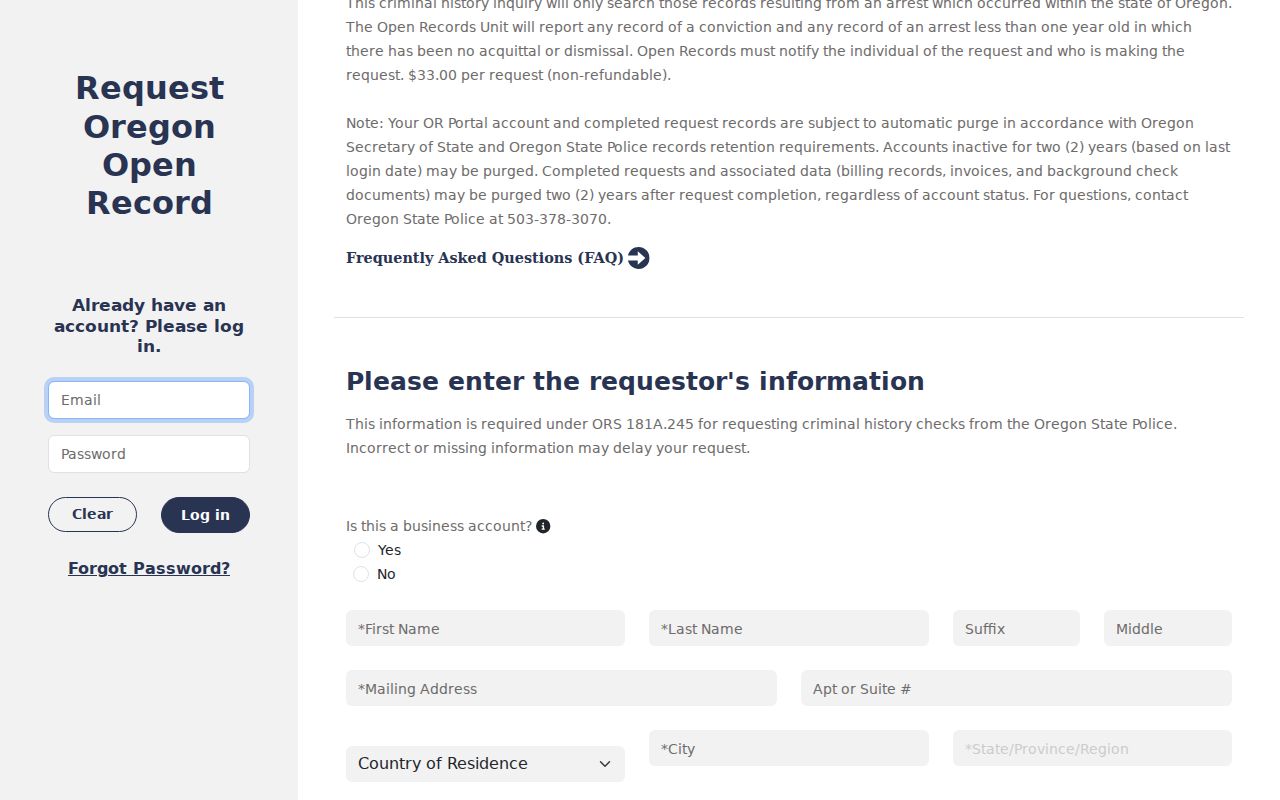
Oregon State Police CJIS offers an Open Record about another person. The report is Oregon-only and name based. It contains Oregon convictions and arrests from the last calendar year when OSP has no acquittal or dismissal; older information is limited to convictions. It is not a national check and can mismatch similar names. The online fee is $33 and nonrefundable. OSP notifies the subject and observes a 14-day statutory period.
The official OSP portal shows the statewide request and account route.
Use the source Oregon court for the filed charging document and final judgment, since an OSP history is only a compiled repository report.
Online fields include requester identity and contact data, subject name and aliases, date of birth, last known address, and card payment. Mail requests use the OSP form and $33 payment. A person seeking their own history uses the fingerprint-supported Copy of Own Record or Clearance Letter procedure instead.
Oregon Record Use Limits
A public Oregon arrest or charge lookup is not automatically a consumer report. Employment, housing, credit, and insurance screening governed by the Fair Credit Reporting Act requires a lawful purpose and the required consumer-reporting procedures. A court search or OSP Open Record does not authorize unrestricted use. Verify identity and final dispositions at the source before drawing any conclusion.
Important: Records displayed here are not an FCRA consumer report and cannot be used for employment, credit, housing, or insurance decisions.
Restricted Oregon Charge Records
Juvenile charges follow role-based access rules. Set-aside adult matters leave ordinary public view. Active police investigations, grand-jury material, victim information, medical data, prosecutor work product, security information, protected addresses, full birth dates, account numbers, and records sealed by order may be withheld or redacted. A court-filed public document must still be requested from the clerk for an official copy.
Oregon also maintains a separate public sex-offender search with statutory disclosure limits. The OSP offender-information source explains registration and classification rules.
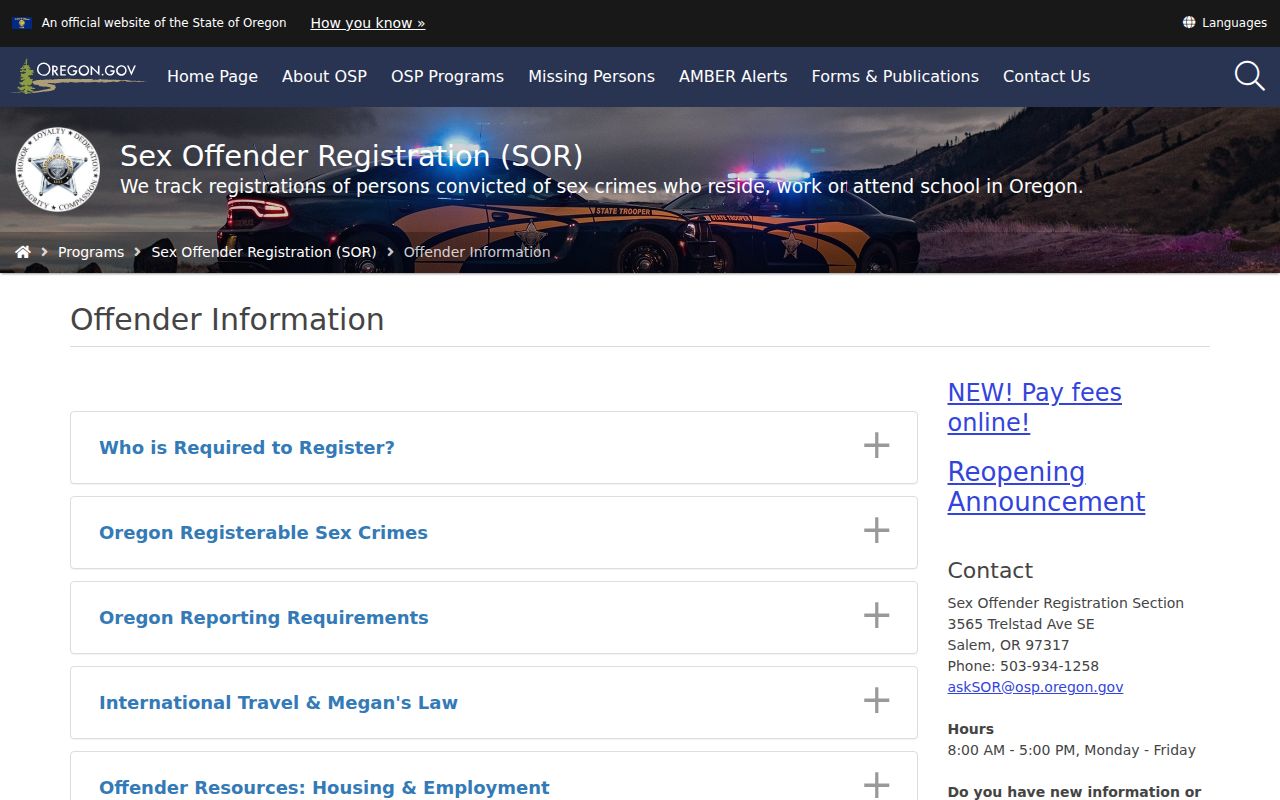
The registry does not include every person arrested or charged and must not be treated as a general Oregon arrest database.
For police material, send a narrow request naming the person, arrest date and place, incident or booking number, and desired record. For judicial charges, search the county or court printed on the case. The arrest county and prosecution venue may differ, so both routes can be necessary.
Grand-jury proceedings are secret, and a “no bill” is not a trial acquittal. Protection-order information can face Internet publication limits. Courts also redact full Social Security and account numbers, protected addresses, confidential sheets, victim and minor data, and other protected identifiers. These document-level limits can apply even when the public case register remains visible.