
What Oregon Probate Covers
Oregon probate handles a decedent's will or intestate estate, appointment of a personal representative, notice to heirs and creditors, asset administration, accounting, distribution, and closure. Intestate means the person died without a valid will. Circuit protective proceedings also address guardianship, which concerns personal decisions, and conservatorship, which concerns financial management. Trust litigation can become a circuit court case, but a private living trust is not automatically filed just because it exists.
The usual court is the Probate Division of Oregon Circuit Court in the county where the decedent resided, or another county allowed by venue law. Oregon has a crucial exception. County courts in Gilliam, Grant, Harney, Malheur, Sherman, and Wheeler may retain probate jurisdiction unless it has been transferred or extended to circuit court. Current local court information should be checked before filing or ordering a record.
Oregon Probate Terms
These terms identify the people, property, and proceedings shown in an Oregon estate or protective case.
- Testator
- A person who made a will.
- Personal representative
- The fiduciary appointed to collect assets, address claims, account, and distribute an estate.
- Intestate
- Dying without a valid will, so Oregon succession law directs distribution.
- Letters
- Clerk-certified proof that a personal representative has current authority to act.
- Guardianship
- A protective proceeding about personal care and decisions.
- Conservatorship
- A protective proceeding about property and financial management.
- Inventory
- The estate property and values reported during administration, subject to access and redaction rules.
Search Oregon Probate Cases
Begin with the free OJD Records and Calendar Search. Search the decedent or personal representative, select the likely county, and use the PB or current probate category. The free result can identify a case number, filing court, parties, dates, status, and register events. It does not supply every filed image. OJCIN OnLine or a free courthouse terminal can provide the fuller register and eligible documents.
- Identify the decedent's residence, property, date of death, and likely filing county.
- Search OJD by name, county, and probate category, recording the exact case number.
- Use OJCIN or a courthouse terminal for eligible documents and the fuller register.
- Order named records from the circuit clerk or confirm the retained county-court route.
- Ask about archive or microfilm retrieval for an older estate absent from the index.
The statewide court-record form can request a will, petition, letters, inventory, claim, account, order, or judgment held by OJD. A retained county court may use OJD tools or a separate clerk workflow. Certified letters are time-sensitive proof, so request a current clerk copy rather than relying on an old portal screen.
Oregon Probate Court Locations
Probate files are local even though OJD provides statewide search and request tools. Most route to an Oregon Circuit Court probate division. The six retained-jurisdiction counties require an extra check because the operative custodian may be a county court probate clerk. A generic county recorder cannot certify probate letters unless that office also serves as probate clerk.
Confirm the custodian: Browse the directory of all 36 Oregon counties, then verify whether the estate is held by OJD circuit court or a county court retaining probate jurisdiction.
Oregon Probate Filing Fees
ORS 21.170 scales appointment and accounting fees by estate value. Publication, bond, service, appearances, copies, and other work can add costs. Current OJD schedules control when statutory amounts are adjusted.
| Item | Amount |
|---|---|
| Appointment petition, estate under $50,000 | $278 |
| Appointment petition, $50,000 to under $1 million | $591 |
| Appointment petition, $1 million to under $10 million | $882 |
| Appointment petition, $10 million or more | $1,176 |
| Annual or final account | $35 to $1,176 by value band |
What Oregon Probate Records Show
A probate result may display the PB case number, court, filing and closing dates, decedent, petitioner, personal representative, attorney, and public heirs or devisees. The file may contain the petition, lodged or admitted will, appointment order, letters, bond, inventory, publication proof, creditor claims, objections, sale requests, account, distribution judgment, receipts, and reopening events. Estate value bands drive filing fees, but exact asset and account information may be redacted.
Guardianship and conservatorship cases add the protected person, visitor or evaluator, fiduciary, capacity findings, annual reports, and accountings. They are not interchangeable with a decedent's estate. Certified letters are time-sensitive proof of current authority. Obtain them from the clerk instead of relying on an old portal printout.
The official OJD probate overview illustrates Oregon estate administration and the small-estate route.
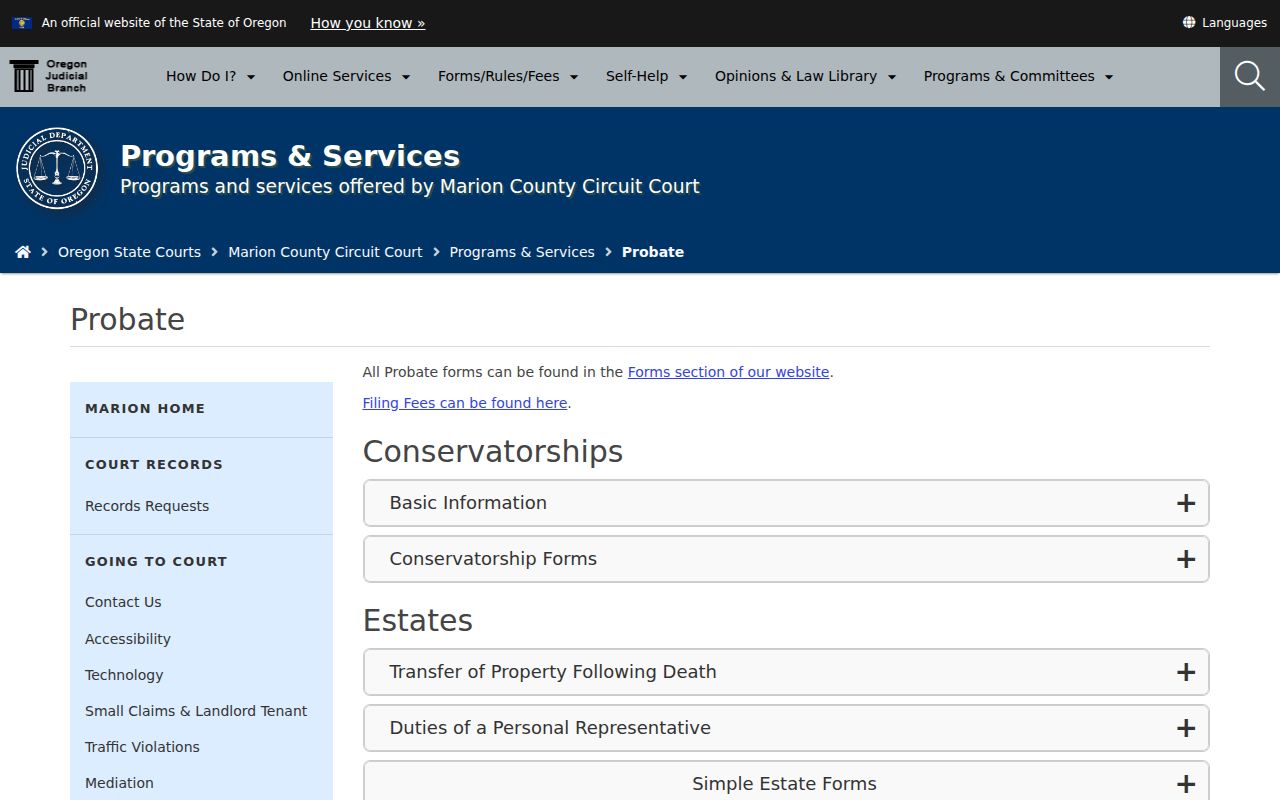
The process source helps distinguish a limited affidavit route from formal appointment and continuing court administration.
Restricted Oregon Probate Information
Public access does not make every probate page open. Death certificates, protected account numbers, medical capacity reports, minor or protected-person addresses, confidential identifiers, and sealed exhibits can be withheld or redacted. A public portal result may still list safe case-level facts. A person seeking a restricted item may need party status, authorization, or a court order under the governing access rule.
Public attendance and media recording are separate issues. A courthouse may allow observation while requiring advance approval for electronic recording. The official OJD public-access example shows how local instructions implement UTCR 3.180.
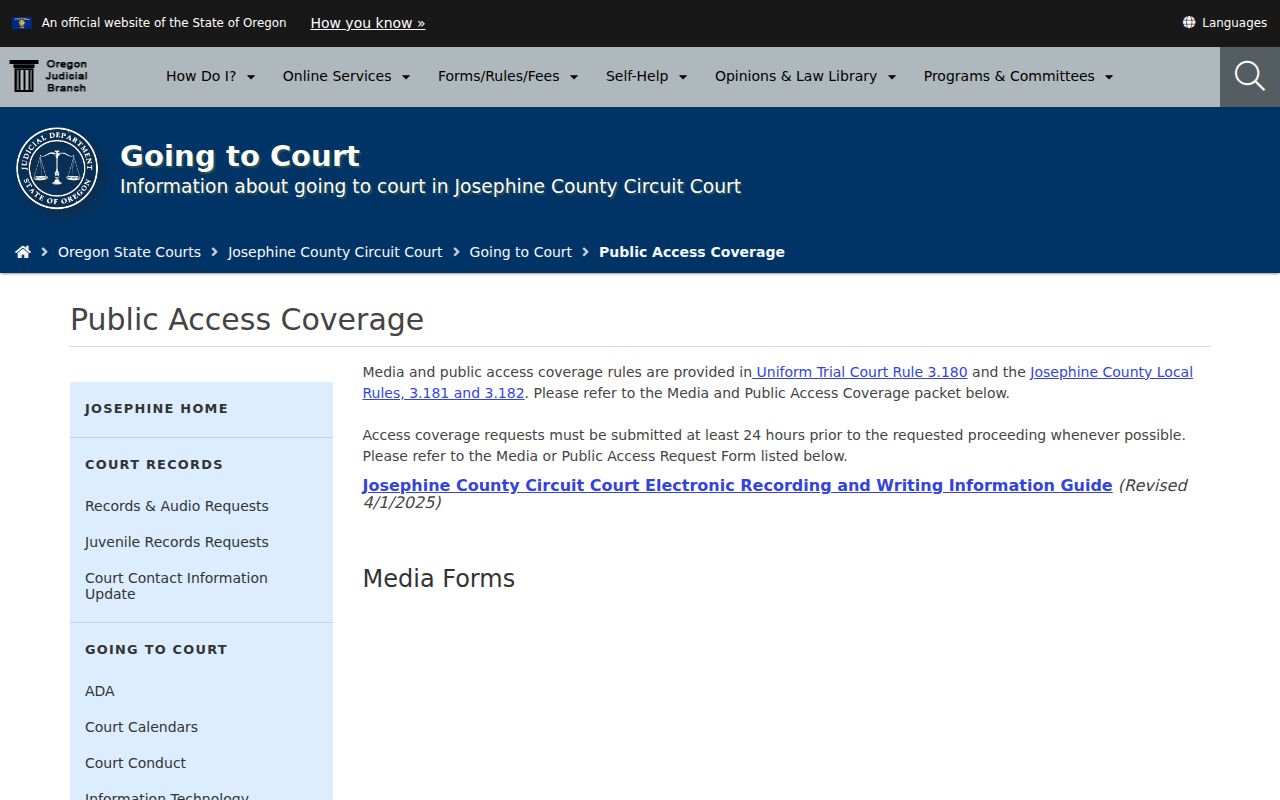
Those courtroom rules do not grant access to confidential exhibits or protected-person information in the case file.
Simple and Formal Oregon Probate
OJD guidance says certain estates below $200,000 may use an Affidavit of Claiming Successor, also called a Simple Estate Affidavit. The current packet controls the asset split, waiting period, liens, exclusions, notices, and value conditions. Older summaries should not be used to assume eligibility. The affiant identifies death and venue, assets and values, liens, expenses, claims, heirs or devisees, the will, and proposed distribution.
Formal probate starts by locating the original will and death certificate, checking venue, and separating nonprobate assets such as beneficiary designations or joint ownership. A petition seeks appointment and letters. After appointment, the personal representative secures assets, publishes and sends notice, handles claims and taxes, accounts, proposes distribution, resolves objections, obtains judgment, distributes property, and closes the estate. Real-estate sales, tax issues, contests, or missing heirs can extend the case.
The official state probate-fee statute supplies the value bands used in the fee schedule.
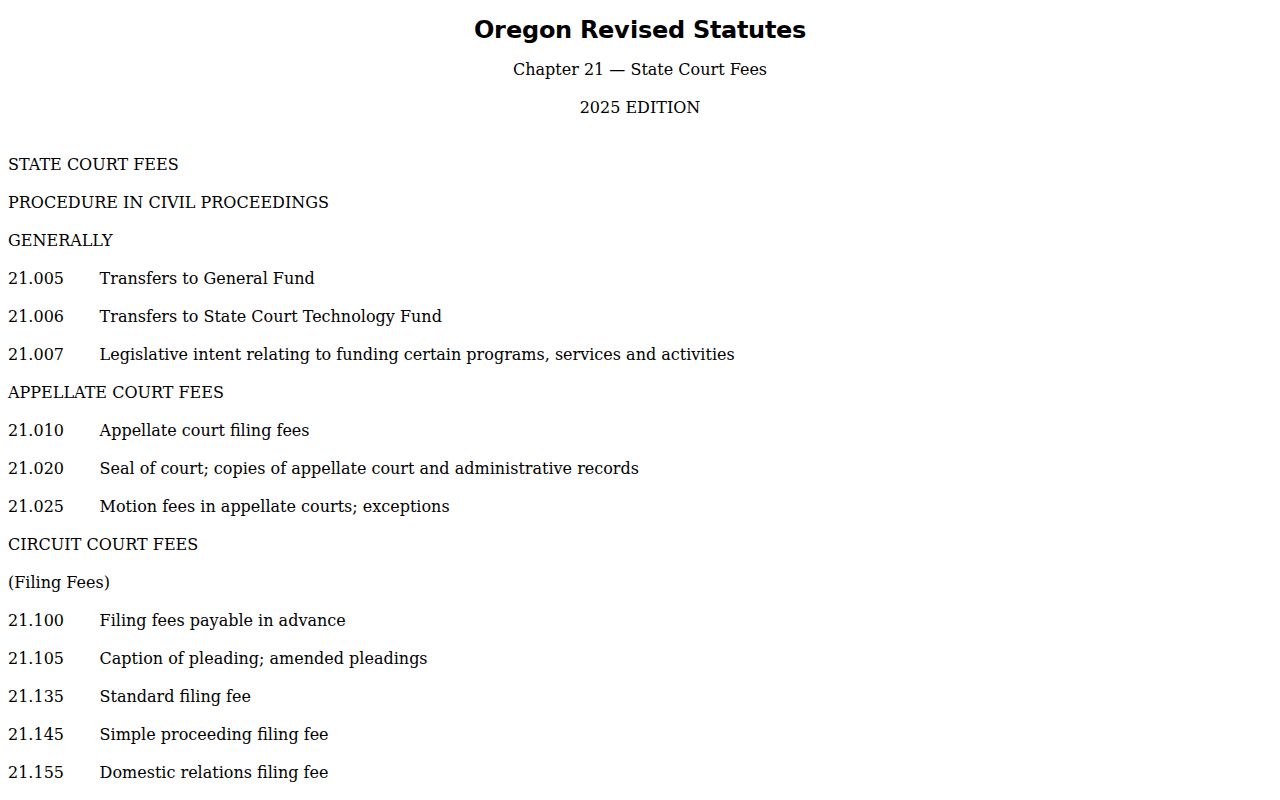
Use the current court schedule with the statute because other filing, copy, and service charges may apply.
Administer an Oregon Estate
Formal administration creates a longer Oregon probate record than a simple-estate affidavit. The petition identifies the decedent, venue, will status, heirs and devisees, estimated value, and proposed personal representative. The court may require a bond before issuing letters. Once appointed, the personal representative publishes creditor notice, gives required direct notices, safeguards property, values assets, addresses valid claims and taxes, and seeks court authority for acts that require approval. The file grows as proofs of notice, inventories, objections, sale motions, creditor matters, and interim orders are entered.
Closure also leaves a record. The personal representative files an account or other closing material, proposes distribution, resolves objections, obtains a judgment, distributes assets, and supplies receipts or other proof needed to close. An estate may be reopened if later property or another qualifying issue appears. No single Oregon completion time applies because real-property sales, tax work, litigation, missing heirs, creditor disputes, and contested wills change the scope. A register marked closed does not show that each private transfer document is public.
Protective proceedings follow a different Oregon path. Guardianship or conservatorship may require notice, a visitor or evaluator, capacity or best-interest proof, a contested hearing, and findings that support the least restrictive arrangement. The appointed fiduciary may then owe periodic reports or accounts. A guardian's role over personal decisions and a conservator's role over finances can coexist, but neither should be treated as the personal representative of a deceased person's estate without a separate appointment.
Older Oregon Probate Records
An absent online result does not prove that no Oregon probate occurred. Older estates can remain in courthouse paper volumes or microfilm, and some materials transfer to Oregon State Archives under retention schedules. Search with spelling variants, an approximate filing year, death date, residence, and names of a spouse, heir, or personal representative. Ask the clerk whether the old docket uses a legacy number or index. A statewide OJD case number may not exist for a proceeding created before electronic conversion.
For legal proof, request the underlying will, appointment order, current letters, or distribution judgment rather than only an index entry. The clerk can explain which copy can be certified. Archive staff may supply a historical reproduction, while a current court clerk determines whether active letters or later filings remain in the judicial file. State the intended use so the custodian can distinguish a genealogy search from a request for present authority.
Find Oregon Probate by County
Identify the county tied to the decedent or authorized venue, then open the full Oregon county directory. Confirm the probate court and clerk before sending a request. Include the decedent's full name and variants, date of death, residence, approximate filing year, case number if known, and exact document needed. Ask for certification when proof of appointment or judgment is required.
In Gilliam, Grant, Harney, Malheur, Sherman, and Wheeler, do not assume that the ordinary OJD circuit presentation resolves custody. ORS chapter 3 preserves the possibility of county-court probate jurisdiction unless it has been transferred or extended. The local probate office can confirm the active route, its search tools, and whether a statewide request form or county process applies.