
Oregon Court System Overview
The Oregon Judicial Department includes the Supreme Court, Court of Appeals, Tax Court, and circuit courts. The Oregon Supreme Court is the single court of last resort. There is no separate criminal high court. The Oregon Court of Appeals is one statewide intermediate tribunal, not a group of geographic appellate districts. Oregon Circuit Court provides general trial jurisdiction in every county, although counties are grouped into administrative judicial districts.
Justice and municipal courts are locally funded and sit outside OJD. A small group of county courts may retain probate jurisdiction. That distinction affects both appeal routes and record access. OJD's statewide tools cover circuit, Tax, and appellate cases, but do not comprehensively index local justice or municipal files.
Usual Oregon appeal path: Circuit Court › Oregon Court of Appeals › discretionary review by Oregon Supreme Court
| Court Level | Court Name | Jurisdiction and Cases | Number in Oregon |
|---|---|---|---|
| Last resort | Oregon Supreme Court | Discretionary review and specified direct matters | 1 court, 7 justices |
| Intermediate appellate | Oregon Court of Appeals | Most circuit appeals and agency judicial review | 1 statewide court, 13 judges |
| Specialized trial | Oregon Tax Court | State and local tax disputes in Magistrate and Regular Divisions | 1 statewide court |
| General trial | Oregon Circuit Court | Criminal, civil, family, juvenile, probate, eviction, small claims, and violations | 36 county courts in 27 districts |
| Local limited trial | Justice Court | Authorized misdemeanors, violations, evictions, and civil or small claims through $10,000 | Varies locally |
| Local municipal | Municipal Court | City ordinances, traffic, parking, and authorized misdemeanors | Varies by city |
| Retained probate | County Court | Limited probate jurisdiction where not transferred | Possible in 6 counties |
Oregon Supreme Court
Seven justices serve on the Oregon Supreme Court, the state's only high court. Oregon judges have six-year, nonpartisan elected terms, and a governor may fill a vacancy until an election. The court decides whether to accept most petitions for review from the Court of Appeals. Its published holdings bind lower Oregon courts.
Some matters reach the Supreme Court directly. They include Regular Division Tax Court appeals, death-sentence review, attorney and judge discipline, and designated election, prison, energy, victim-rights, habeas, and mandamus proceedings. A denied petition leaves the Court of Appeals ruling in place without adopting every part of its reasoning.
One Oregon Court of Appeals
The Oregon Court of Appeals is one statewide court. Its 13 judges normally work in four three-judge panels. Those panels are not four geographic districts, and a county does not select an appellate panel. The court hears most civil and criminal circuit appeals plus judicial review of state administrative decisions. An appeal reviews claimed legal error from the trial record rather than retrying witnesses.
| Organization | Judges | Coverage |
|---|---|---|
| Single Oregon Court of Appeals | 13 judges, generally four panels | All 36 counties and statewide agency review |
Oregon Circuit Court Trials
Oregon Circuit Court is the general-jurisdiction trial court. It hears felonies, misdemeanors, tort and contract actions, domestic relations, juvenile matters, probate where jurisdiction has transferred, protective orders, landlord-tenant cases, small claims, and state-law violations. Small claims can reach $10,000. Specialized drug, mental-health, veterans, family-treatment, DUII, and other problem-solving calendars remain parts of circuit court rather than separate constitutional courts.
Every county has a circuit court, but OJD groups them into 27 administrative judicial districts. Several rural districts cover two or more counties, and judges may serve across county lines. The case caption still identifies the Circuit Court of the State of Oregon for the filing county. That county's OJD clerk holds the official trial file and certified copy authority.
The Uniform Trial Court Rules source shows the statewide procedural framework applied across circuit courts.
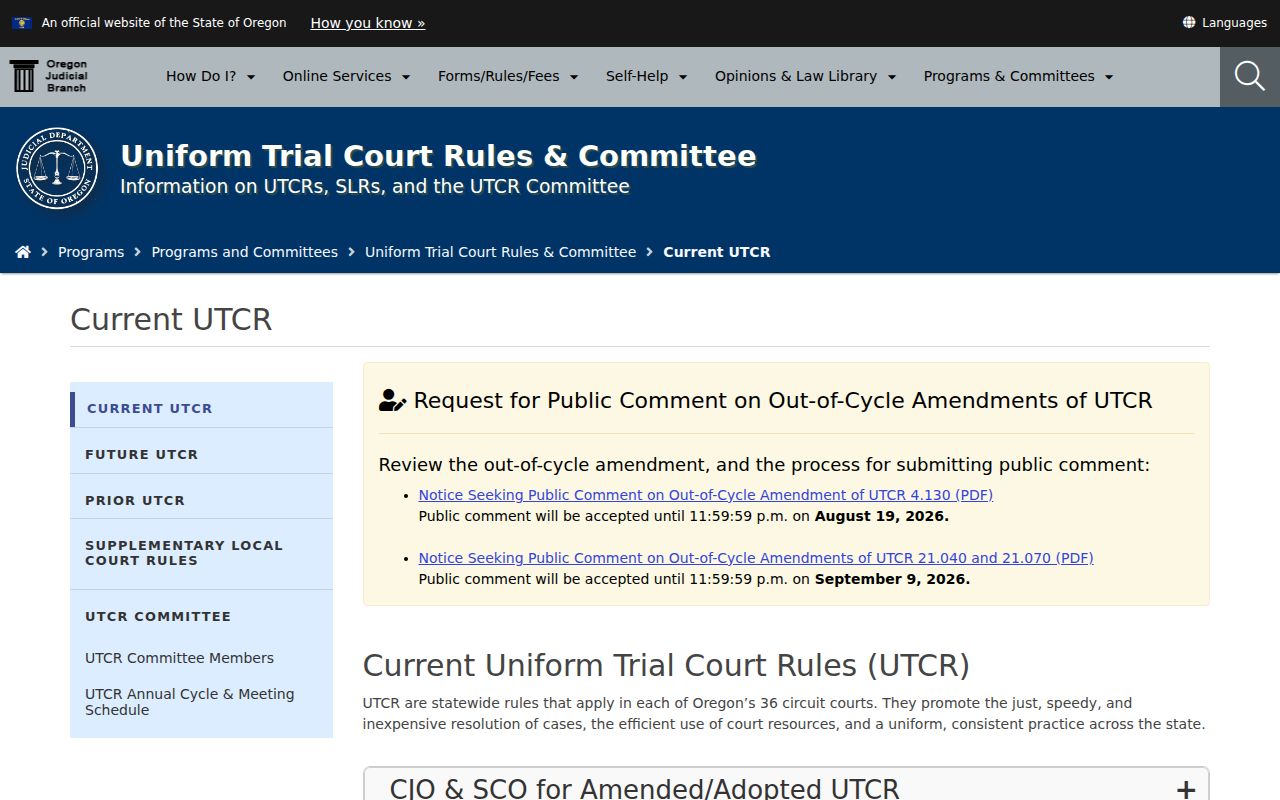
Uniform filing and access rules support statewide administration even when the case itself remains tied to one filing county.
Oregon Court Jurisdiction Compared
The correct tribunal depends on subject, location, and whether the case is a trial or appeal. Local courts are not simply smaller OJD branches.
| Oregon Circuit Court | Justice Court | Municipal Court | |
|---|---|---|---|
| Organization | State-funded OJD court | Locally authorized county court | City court outside OJD |
| Criminal scope | Felonies, misdemeanors, violations | Authorized misdemeanors and violations | City ordinance, traffic, parking, and authorized misdemeanors |
| Civil scope | General civil, family, eviction, small claims | Eviction and civil or small claims through $10,000 | No general civil jurisdiction |
| Statewide index | OJD Records Search | Not comprehensively indexed | Not comprehensively indexed |
| Record custodian | OJD circuit clerk | Justice court clerk | Municipal court clerk |
How Oregon Cases Move
A circuit case starts with a complaint, petition, indictment, information, or citation. The clerk assigns an OJD case number and judicial officer after the fee is paid or waived. Service in a civil case or arraignment in a criminal case gives formal notice. Motions, discovery, settlement conferences, hearings, trial, and judgment create the register of actions.
Criminal case flow: Arrest or citation › First appearance › Complaint, information, or indictment › Circuit Court arraignment › Pretrial › Plea or trial › Disposition and sentence › Court of Appeals › Supreme Court petition
Civil case flow: Complaint or petition › Service › Answer › Discovery and motions › Settlement or trial › Judgment › Court of Appeals › Supreme Court petition
Special routes alter that chain. Tax Court Magistrate decisions can receive de novo proceedings in the Regular Division, whose decisions go to the Supreme Court. Death-sentence cases and other matters specified by law also receive direct high-court review. Local court appeals depend on the tribunal and whether it is a court of record.
Oregon Trial Court Divisions
Circuit courts use civil, criminal, family, juvenile, probate, small-claims, eviction, and violation calendars. In a larger court, judges and staff may specialize. In a rural district, a judge may handle several categories or serve more than one county. These divisions remain part of the same Oregon Circuit Court, and the OJD circuit clerk remains the record custodian.
Case type affects access. Juvenile, adoption, medical, treatment, protected-address, and other confidential material may be unavailable from the public portal even when a public case category is indexed. A specialized calendar does not create a separate public-record rule. The official case and any access restriction remain tied to the filing court and document.
Local Oregon Courts Outside OJD
Justice courts can hear locally authorized misdemeanors, violations, evictions, and civil or small claims not over $10,000. Municipal courts enforce city ordinances and commonly hear traffic, parking, and authorized misdemeanor cases arising in the city. Their clerks, portals, payment tools, and record rules are local. A citation printed with a municipal or justice court name should be taken directly to that court.
The OJD Jury Task Force materials compare the state circuit system with local municipal and justice courts.
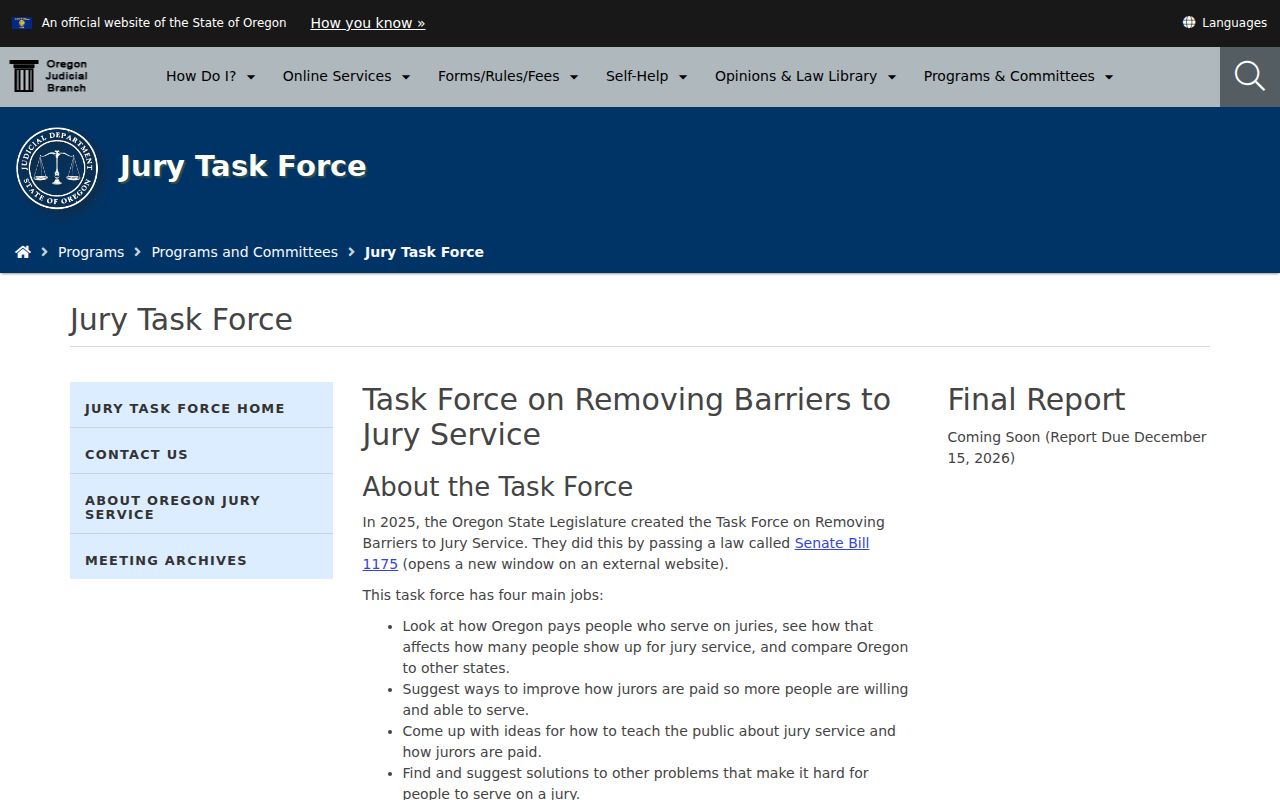
The distinction explains why an OJD search can be statewide for OJD courts yet still omit a valid local case.
Oregon Tax Court
The Oregon Tax Court is a specialized statewide trial court. Taxpayers generally begin in the Magistrate Division. A dissatisfied party may seek a de novo proceeding in the Regular Division, meaning the matter is heard anew under that process. A Regular Division decision appeals directly to the Oregon Supreme Court. Tax Court filings belong in OJD and OJCIN, not in a request to an ordinary county assessor as though it were the court record.
Federal Courts in Oregon
Oregon is one federal judicial district, the U.S. District Court for the District of Oregon. Federal criminal, constitutional, diversity, agency, and other federal matters use that court, not OJD. The U.S. Bankruptcy Court for the District of Oregon maintains a separate bankruptcy docket. Both use PACER for electronic federal dockets and documents.
Federal appeals go to the Ninth Circuit Court of Appeals and potentially the U.S. Supreme Court. A caption saying United States District Court identifies a federal case. A caption saying Circuit Court of the State of Oregon identifies a state trial case. State divorce, probate, ordinary traffic, and state charges do not become federal just because a party lives in Oregon.
History of Oregon Courts
Oregon's judicial history predates statehood. Territorial settlers appointed a first Supreme Judge in 1841, and the 1859 Constitution established state judicial power. The Court of Appeals was created in 1969 as one statewide intermediate court. Modern unification later placed central administrative authority in the Chief Justice while municipal and justice courts remained local.
Oregon eCourt grew from legislative review and financing in the late 2000s into statewide circuit implementation during the 2010s. OECI now covers all 36 circuit courts, though older document images depend on each court's conversion date. The OJD legal-pioneers history project adds statewide civic context.

The historical record also shows how electronic statewide access developed from courts that once relied on circuit riding and local paper files.
Find Oregon Courts by County
Browse the directory of all 36 Oregon counties to reach the filing county's circuit court and identify any justice or municipal court serving the area. Use the exact court printed on a citation, judgment, or case caption. An OJD case belongs with the circuit clerk, while a local city or justice case must go to that court's clerk. Certified copies come from the originating court.