
Oregon Clerk Functions Are Split
Oregon is unified for OJD circuit-court administration but functionally split between judicial and county offices. A Trial Court Administrator oversees circuit operations, and circuit clerks maintain the official criminal, civil, family, juvenile, probate, protection-order, eviction, small-claims, and violation files. Those staff are state judicial employees. The elected County Clerk is usually the recorder, elections officer, and marriage official, not the custodian of circuit cases.
Additional clerks serve the Oregon Tax Court, appellate courts, municipal courts, and justice courts. Appellate records route to the Appellate Court Records Section. A city misdemeanor or municipal citation stays with the municipal clerk. A justice-court misdemeanor, violation, eviction, or small claim stays with the justice clerk. The office name in the case caption or on the citation controls.
Oregon Circuit Court Clerks
Each Oregon circuit court has an OJD clerk operation under its Trial Court Administrator. This office accepts pleadings, assigns case numbers, maintains the register and file, supports hearings, collects court fees, supplies permitted documents, and certifies official copies. It is the primary route for a felony or misdemeanor case, general civil action, divorce and custody matter, juvenile proceeding, circuit probate, protective order, eviction, small claim, or state violation.
- Circuit criminal, civil, family, and juvenile cases
- Probate and protective proceedings heard in circuit court
- Protection orders, evictions, small claims, and violations
- Public filed documents, audio requests, and certified judgments
- Older circuit paper or microfilm records held locally
Elected Oregon County Clerks
The elected County Clerk performs county functions apart from the state court file. Typical duties include issuing and recording marriage licenses, running elections, recording deeds and liens, and maintaining other county instruments. Exact recorder arrangements vary locally. A county clerk does not become custodian of a circuit criminal, civil, or divorce case simply because both offices use the county name or occupy the same courthouse.
- Marriage-license applications and completed marriage returns
- Deeds, recorded liens, and other land-record instruments
- Election records and county election administration
- Locally held assumed-business or recording records
Which Oregon Clerk Holds What
Choose the office by function. Separate local courts and statewide appellate or Tax Court clerks remain outside this two-office comparison.
| Record / Case Type | OJD Circuit Clerk | Elected County Clerk |
|---|---|---|
| Felony and circuit misdemeanor cases | Yes | No |
| General civil, divorce, custody | Yes | No |
| Circuit probate and guardianship | Yes | Only if designated for retained county probate |
| Marriage licenses and returns | No | Yes |
| Real property and deed records | No | Yes or county recorder arrangement |
| Municipal or justice case | No | No, use that local court clerk |
Oregon Court Clerk Duties
OJD clerks preserve the official case file and control access under court rules and statutes. Their work differs from a public-record officer answering a request for agency policy or procurement material. Oregon Public Records Law applies to public bodies, but an ORS chapter 192 request does not force a court clerk to disclose a sealed case or create a record that does not exist.
- Accept filings and maintain the case register
- Protect confidential and access-restricted material
- Collect filing fees, fines, and copy payments
- Provide public terminals and retrieve older files
- Issue plain, certified, and exemplified court copies
- Process permitted audio and document requests
The official Oregon public-record statutes are a useful boundary reference.
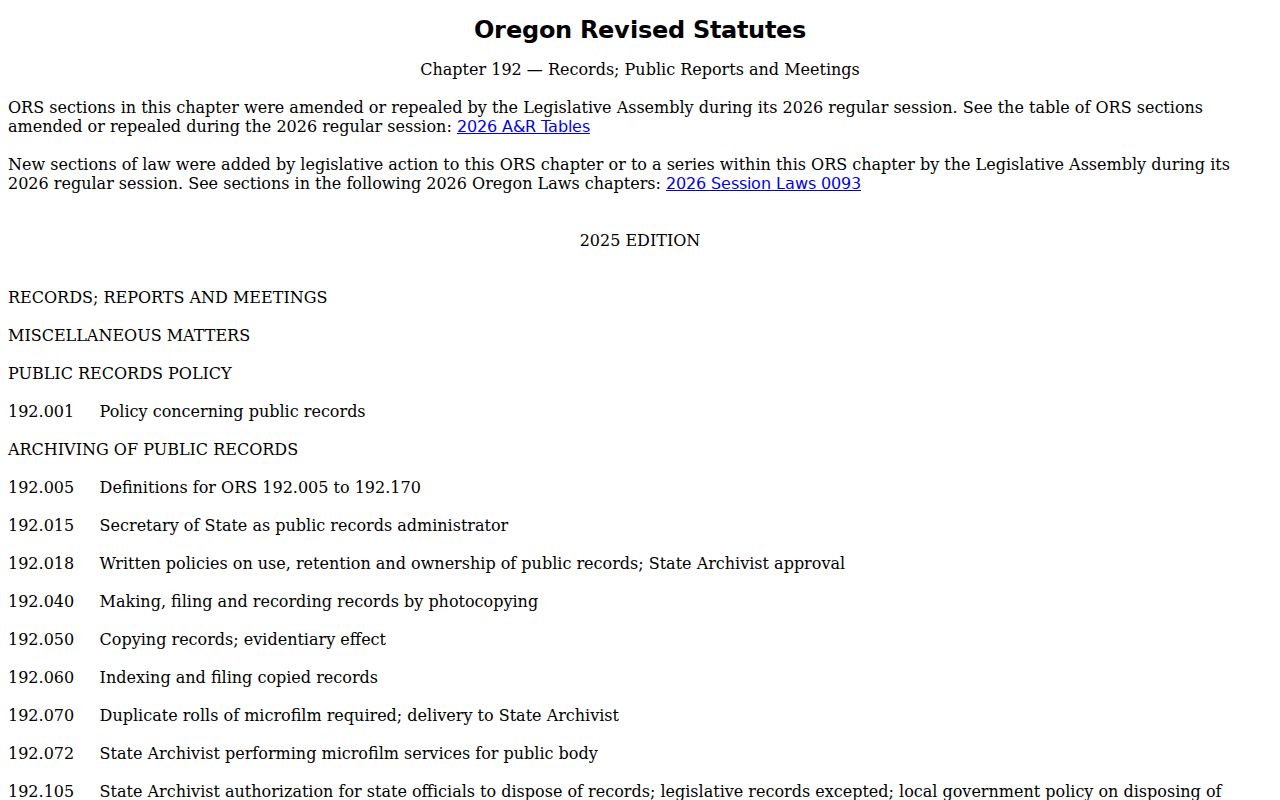
The statutes do not collapse the separate judicial, county, municipal, and justice custodians into one records office.
Request Oregon Certified Court Copies
A certified copy carries the circuit clerk's certificate and seal as a true copy. An exemplified copy adds further clerk and judge authentication for some interstate or foreign uses. A plain copy only reproduces the filing. Ask the receiving institution which form it requires before paying.
- Use free OJD search to identify the exact court, case number, parties, and filing dates.
- Name the document, such as a judgment, petition, order, or indictment, and give its filing date when possible.
- Submit the statewide court record request, mail the form, or visit the holding court.
- Select electronic, mail, or pickup delivery where offered and request certification or exemplification expressly.
- Approve the estimate and prepay when required. The clerk produces the permitted record through the selected channel.
Oregon Court Request Fields
The statewide form routes circuit, Tax Court, Court of Appeals, and Supreme Court documents or audio. Multnomah uses its linked local workflow.
| Field | Required | Notes |
|---|---|---|
| Requesting court | Yes | Select circuit county, Tax, appellate, or Supreme Court. |
| Requester identity and email | Yes | Email receives estimates and follow-up. |
| Phone and mailing address | Conditional | Needed for clarification or physical delivery. |
| Case number and name | Strongly requested | The exact OJD number prevents a name-only search delay. |
| Document or hearing | Yes | Give title and filing date, or hearing date for audio. |
| Delivery and authentication | Yes or optional | Choose delivery; add certification or exemplification if needed. |
OJD says a court may take up to five court business days to respond and ten or more court business days to complete some requests. Complex retrieval, review, redaction, certification, or older-file work can extend completion. If the requester does not answer a court follow-up within 60 court business days, the request closes. A written fee-waiver request may be considered, but public interest or inability to pay does not guarantee that a fee will be waived.
Use the administrative public-record channel only for OJD operational material. A request for a filed pleading, court audio, judgment, or case exhibit belongs on the case-record form. OJD need not create a custom report, conduct open-ended research, or answer legal questions. Narrow dates and exact record titles make the custodian's estimate more useful and reduce the risk of retrieving the wrong case.
Oregon Court Clerk Fees
OJD uses statewide court-copy pricing. County clerks publish separate marriage, recording, staff-time, mailing, and vendor-card charges. The court estimates likely costs above $25 and may require written approval or advance payment.
| Item | Amount |
|---|---|
| Electronic stored court document | $3 per case request; no electronic delivery charge |
| Paper court copy | Commonly $3 per request plus $0.25 per page |
| Certified court copy | $5 certification plus $0.25 per page |
| Exemplified court copy | $10 authentication plus $0.25 per page |
| Microfilm conversion | $0.45 per page |
| Judicial proceeding recording | $9 electronic or $10 CD |
A judicial recording is not a transcript. A transcript may require a separate transcriber and processing cost. Likewise, certification authenticates the court copy but does not transform a portal printout into the official record. Electronic document availability also depends on the file's age, the county's Oregon eCourt implementation date, and the document's access class. Older or protected material may require clerk retrieval even when the case register is online.
Oregon Court Clerk Forms
OJD provides statewide forms for court copies, audio, case filing, and fee relief. County clerks maintain separate marriage and recording forms.
- Court Record and Audio Request for circuit, Tax, and appellate records
- OJD statewide forms library for case-type and fee-relief forms
- OJD fee resources for current filing and copy schedules
Oregon Online and Counter Access
OJD offers three records paths. Free Records and Calendar Search provides basic case and hearing information but no filed images. OJCIN OnLine supplies OECI circuit and Tax Court registers plus ACMS appellate records to subscribers, with permissible documents dependent on access class and eCourt implementation date. Every circuit courthouse also provides a free public OECI terminal, where public documents can be viewed under clerk supervision.
Oregon eFile and appellate eFile serve filing functions through OJD's online services. A mail or counter request remains important for older paper or microfilm records, certification, and users unable to complete an online request. County marriage and recording systems are separate and may use local online pre-applications or search tools.
Oregon Administrative Records
Policy, procurement, employee, budget, and aggregate administrative material is not a case-copy request. It goes to OJD's Public Records Administrator through the administrative workflow. The request should identify an existing record, date range, preferred format, and cost limit. OJD does not have to create a new report or answer questions in place of producing records.
Similarly, an agency request goes to the agency that has the record. Oregon DOJ publishes public-record guidance but does not warehouse the files of every state and local body. A sheriff report, prosecutor file, marriage return, and circuit judgment can involve four different custodians.
Find Oregon Clerks by County
Browse the full directory of all 36 Oregon counties to reach the circuit court and elected county clerk serving the relevant place. For an OJD case, use the county of filing. For a marriage record, use the issuing county. For a local citation, use the municipal or justice court printed on it. Confirm counter hours, payment, mail address, and local forms before submitting a request.