
Oregon Court Dockets Defined
Oregon usually calls the chronological docket the register of actions. Each line can identify an event date, filing or hearing type, filing party, judicial action, disposition, and whether a document is available through an authorized system. The register is an index and history. It is not the complaint, motion, exhibit, order, judgment, transcript, or audio itself. A filed entry only means the clerk accepted an item. It does not mean the judge granted the relief requested.
Oregon Circuit Courts create the broadest trial dockets because they hear felonies, misdemeanors, civil actions, family cases, juvenile matters, probate, evictions, small claims, protection proceedings, and violations. The Oregon Tax Court has Magistrate and Regular Division dockets. The Court of Appeals and Supreme Court maintain appellate registers. Locally funded municipal and justice courts sit outside OJD, so their citation and misdemeanor dockets may not appear in statewide results.
A circuit register grows from the first accepted complaint, petition, indictment, information, or citation. Service or arraignment follows. Motions, responses, conferences, hearings, trial, and judgment add dated lines. A notice of appeal and later appellate mandate can appear after trial judgment. Venue changes, judicial assignments, and reopened enforcement can also extend an Oregon docket well past the initial case closure.
- Register of actions
- The dated official log of filings, hearings, notices, orders, judgments, reminders, and case closure.
- Calendar
- A schedule of future or recent proceedings that may change after publication.
- Case file
- The actual public documents and other material associated with register entries.
Search Oregon Court Dockets
The free OJD Records and Calendar Search provides basic case and hearing data for all 36 circuit courts, the Tax Court, Court of Appeals, and Supreme Court. It has Smart Search and hearing-search controls. Search by exact OJD number when known, or combine a party name with location, category, and date filters. The free result gives public event and status information but no filed document images.
- Open OJD Records and Calendar Search and choose a case or hearing search.
- Enter the exact case number, or use the party name with a filing location.
- Open the result and check the caption, category, filing date, status, and parties.
- Read events in date order and verify future hearings with the filing clerk.
- Move to OJCIN, a courthouse terminal, or the clerk when a public document is needed.
OJCIN OnLine supplies registered remote access to OECI circuit and Tax Court registers and ACMS appellate records. Permitted document images depend on access class and each circuit's Oregon eCourt implementation date. Every circuit courthouse offers a free OECI terminal. Older paper or microfilm records and official copies require the court clerk.
The free portal covers OJD state courts, not every Oregon tribunal. A municipal parking docket, city misdemeanor, or justice-court violation may exist only through a local portal or clerk. The elected county clerk is also not the circuit docket custodian. Oregon judicial files stay with the OJD circuit clerk under the Trial Court Administrator, while the elected county clerk generally handles marriage, election, deed, and recording work.
Read Oregon Docket Entries
A register must be read as a chain. One entry rarely supplies the whole outcome. A motion can be followed by a response, hearing, order, amended order, and appeal. Criminal counts may end differently within the same case. Financial entries can reflect an amount imposed, a later payment, adjustment, plan, or satisfaction. The clerk's official register resolves unfamiliar legacy wording.
| Field | What It Shows |
|---|---|
| Entry Date | Date the clerk recorded the filing, notice, hearing, order, or other event |
| Event Type | Complaint, service, plea, motion, response, hearing, judgment, appeal, mandate, or closure |
| Filing Party | Public party or attorney associated with an accepted filing |
| Hearing Detail | Date, time, type, judicial officer, courtroom, and released outcome where available |
| Disposition | Outcome of a claim or count, not merely the overall open or closed case label |
| Document Access | Free portal has no images; OECI or a terminal may show eligible public files |
Common OJD case numbers begin with a two-digit year and a two-letter category. CR denotes a criminal presentation, CV general civil, VI violation, and PK parking. Probate, family, small-claims, eviction, legacy, and local codes vary. “Filed” is not “granted.” “Continuance” moves an event. “Dismissed without prejudice” may allow timely refiling, while “with prejudice” ordinarily ends that claim in the same form.
Party roles also matter. A plaintiff begins a civil action. A petitioner asks for relief in a petition-based matter, and a respondent answers it. In a criminal case, the State of Oregon prosecutes the defendant. A disposition is the outcome, while a judgment formally establishes rights, liability, conviction, sentence, or relief. These labels help separate an event from the legal effect that follows.
Oregon Courts With Dockets
OJD's statewide tools cover circuit, Tax, and appellate courts. Circuit cases use OECI, while appellate registers use ACMS. Published appellate opinions are also available through OJD. Local municipal and justice courts may offer their own portal, counter search, mail process, or written public-record channel. Search the court printed on a citation, release agreement, complaint, or warrant before choosing a system.
- Circuit courts: free basic search, OECI, public terminal, and clerk copy channels.
- Tax Court: statewide search and OECI for Magistrate and Regular Division matters.
- Appellate courts: free search, ACMS, publications, and the Appellate Court Records Section.
- Justice and municipal courts: local clerk channels that are not comprehensively indexed by OJD.
Adoption is a major exception to ordinary docket access. OJD's official adoption access source explains confidentiality and release routes.
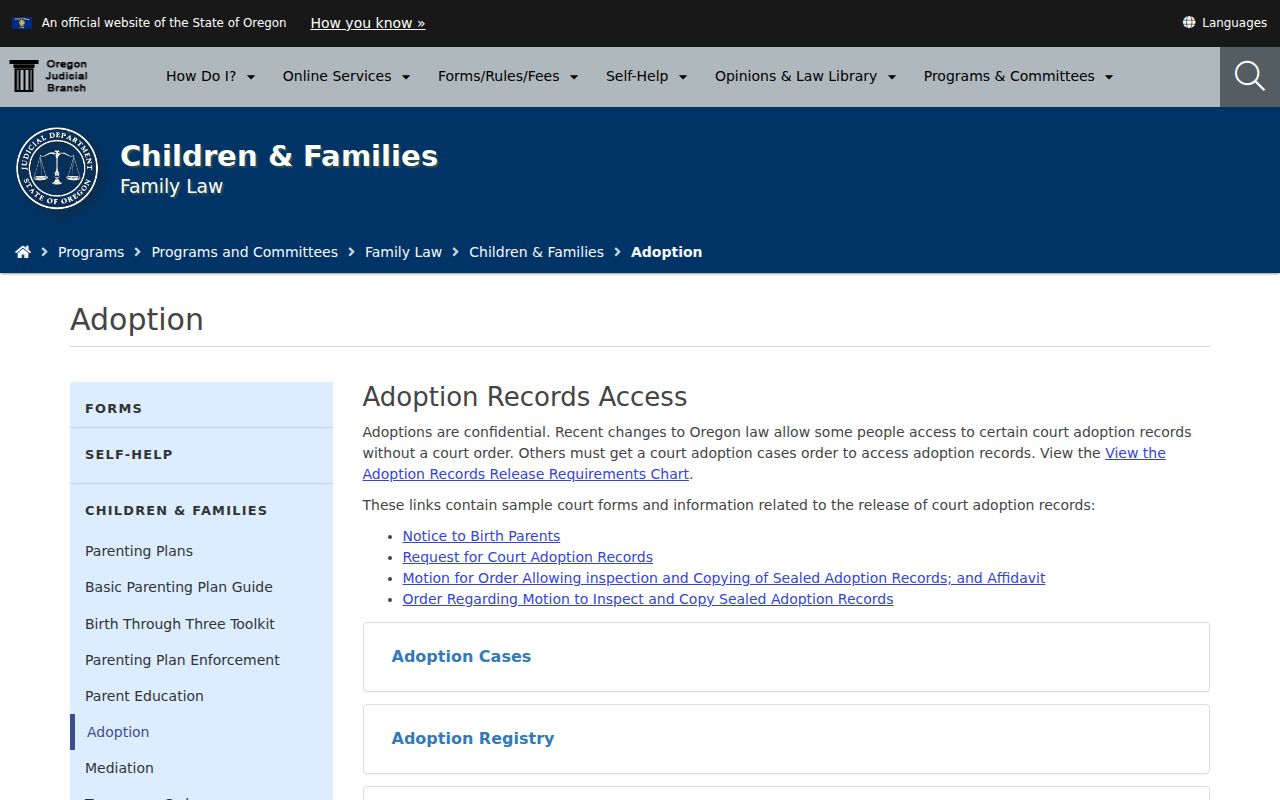
An absent adoption docket is a confidentiality result, not proof that no Oregon proceeding occurred.
Juvenile delinquency and dependency dockets also follow role-based access under Oregon law. Civil commitment matters are excluded from the free search. Protected-order data may be suppressed from Internet publication, and set-aside criminal matters leave ordinary public access. Public registers also omit full birth dates, Social Security and account numbers, protected addresses, and other confidential information even when the rest of a case remains open.
Oregon Docket vs Case File
The free Oregon docket is best for discovery and tracking. The full case file supports legal review because it contains the wording of complaints, motions, declarations, orders, and judgments. Exhibits can have separate custody rules. Transcripts must usually be ordered from a reporter or transcriber, and digital audio has its own request and charge. Certified copies come only from the clerk, not from the free search or a private service.
| Docket | Full Case Record | |
|---|---|---|
| Format | List of entries | Full documents |
| Access | Free OJD search or fuller OJCIN register | OECI, courthouse terminal, or clerk request |
| Use | Track progress and identify dates | Read exact allegations, arguments, and rulings |
| Official status | Online service aids research | Clerk can issue certified copies |
Supply the exact court, number, document name, and filing date when ordering. OJD's statewide form handles circuit, Tax, and appellate documents and audio, with a dedicated local workflow for Multnomah. Older records may require paper or microfilm retrieval. A court may estimate costs and request advance payment before copying.
Public Oregon docket research can be free, but documents are not always free. A common paper copy is $3 per request plus $0.25 per page. Certification is $5 plus page charges, and exemplification is $10 plus page charges. An electronically delivered stored document request is commonly $3 per case. Judicial audio is generally $9 electronically. The court's current quote controls.
Verify Oregon Docket Status
Read the caption and case status first, then follow each claim or criminal count to its last disposition event. An open case can contain dismissed counts. A closed case may later reopen for enforcement, an amended judgment, appeal, or post-conviction work. “Guilty,” “no contest,” “acquitted,” “dismissed,” and “diversion” are distinct results. Do not turn a filed accusation into a conviction.
Hearing calendars can change. Verify the time, courtroom, remote link, and status with the clerk before travel. The Oregon county directory routes to the correct circuit court. Locally prosecuted matters need the relevant city or justice clerk. That local route also resolves court-specific abbreviations and records omitted from the OJD portal.
Appellate entries require a different reading pattern. A notice of appeal starts review of the trial record. Briefing, motions, oral argument, opinion, judgment, and mandate follow as applicable. The Court of Appeals reviews legal error rather than retrying witnesses. A petition for Supreme Court review does not guarantee review, and denial leaves the appellate result intact without approving each part of its reasoning.
Federal Dockets in Oregon
Federal dockets use a separate system. The U.S. District Court for the District of Oregon maintains federal civil and criminal cases.
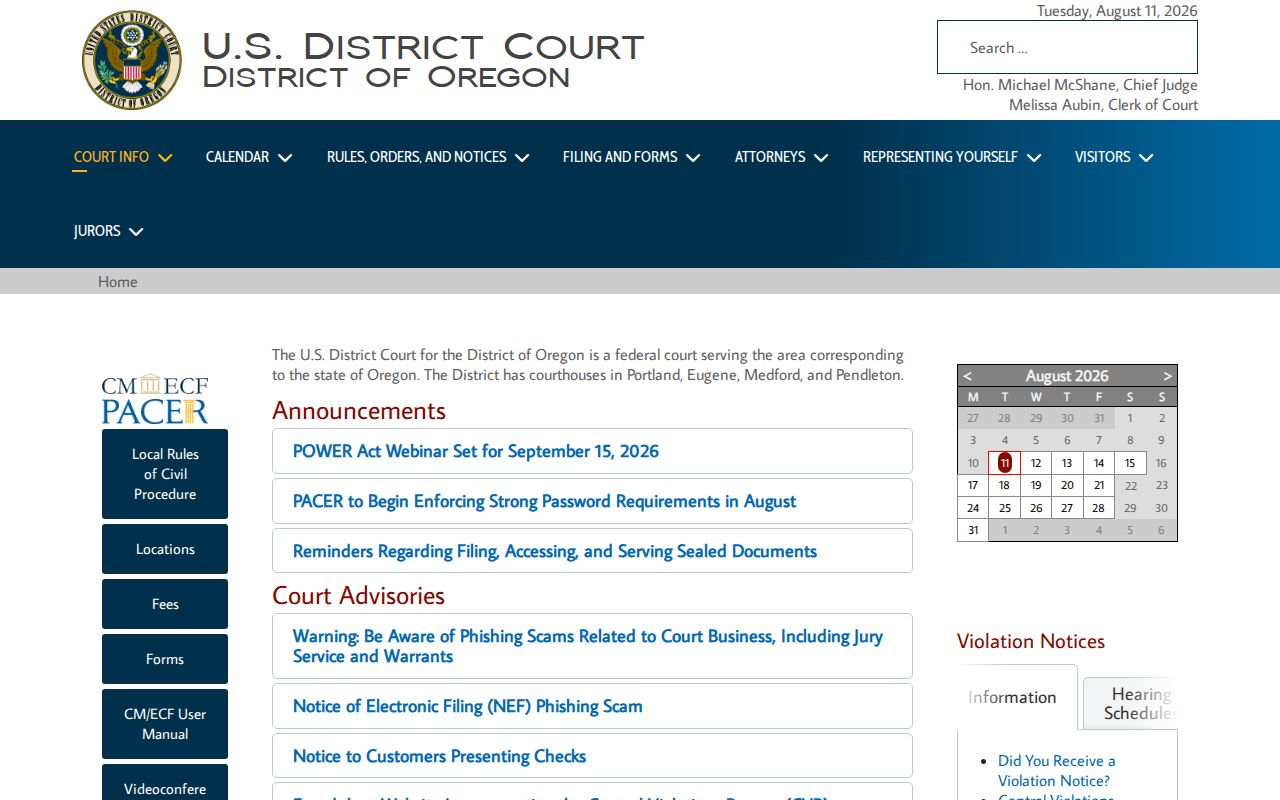
Its CM/ECF records and rules do not appear in Oregon's OJD portal.
The U.S. Bankruptcy Court for the District of Oregon maintains bankruptcy dockets.
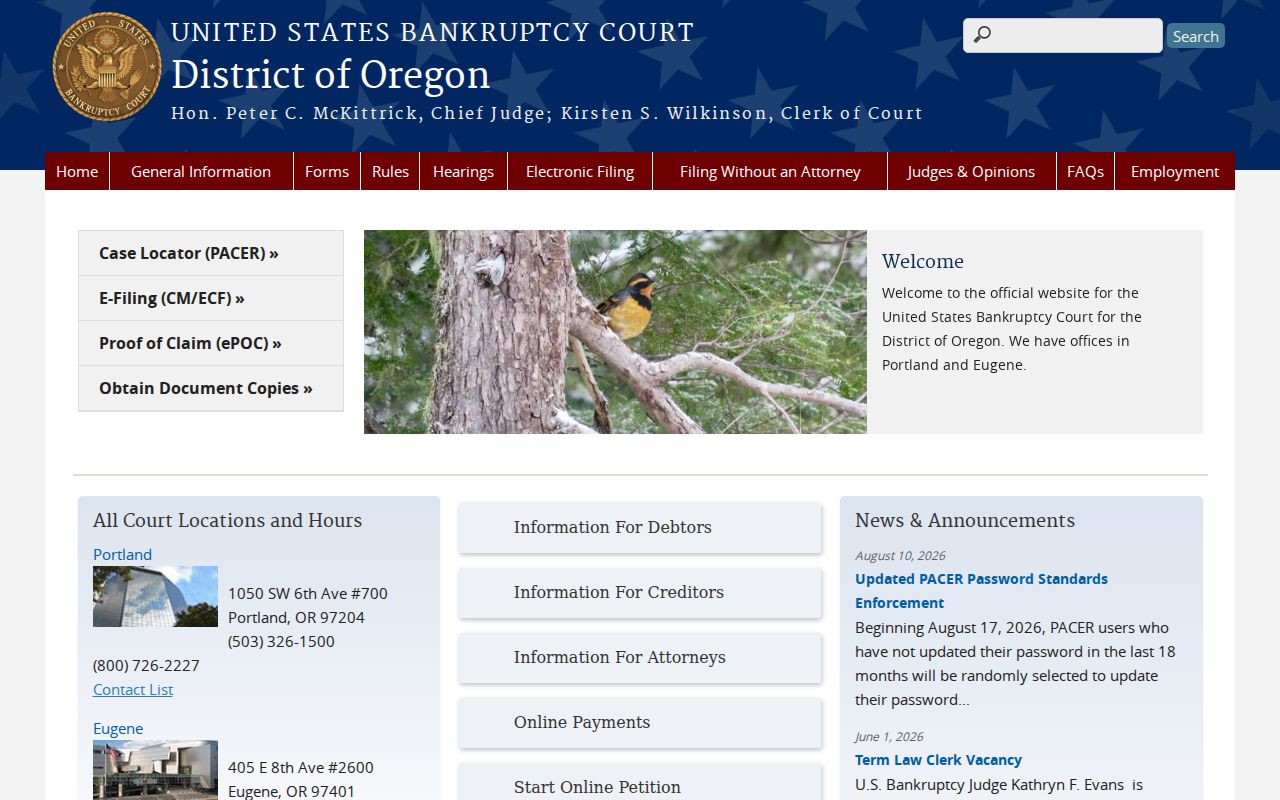
Bankruptcy filings require the federal route even when a debtor also has an Oregon state case.
Appeals from the federal district court go to the United States Court of Appeals for the Ninth Circuit.
The Ninth Circuit is not the Oregon Court of Appeals and keeps a distinct federal appellate docket.
PACER provides registered electronic access to federal court records and a national case locator.
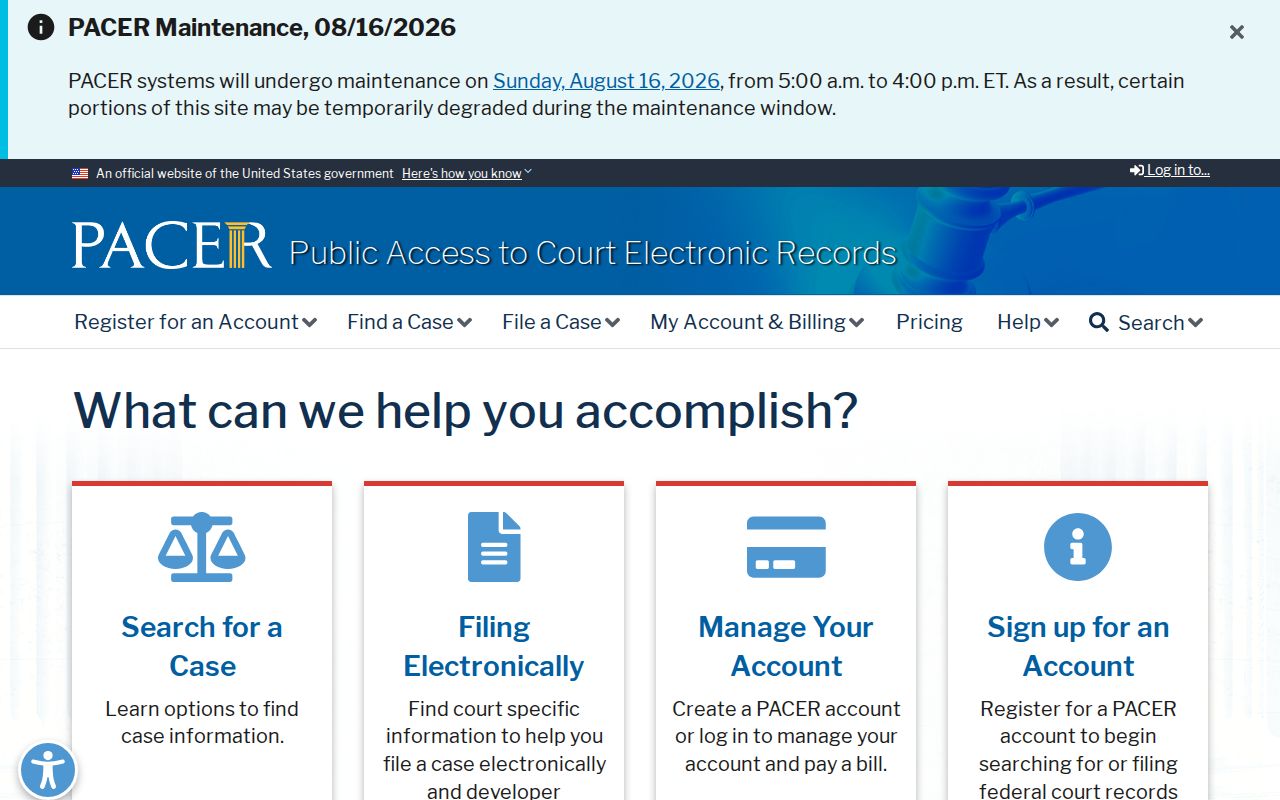
PACER does not supply certified Oregon state court records or replace an OJD circuit clerk.