
Oregon Criminal Court Case Files
A court file answers what Oregon prosecutors formally charged, how the defendant pleaded, what the judge ordered, and how each count ended. It is distinct from Oregon arrest and charge records, which begin with police custody and prosecutor review. It is also distinct from a live jail or prison profile. The criminal clerk's file can contain a complaint, information, indictment, release order, counsel entry, motion, plea document, judgment, restitution order, probation terms, and appeal events.
Oregon Circuit Courts hear felonies and misdemeanors. Authorized municipal and justice courts can hear misdemeanors and violations within local and statutory limits. The OJD circuit clerk, not the elected county clerk, holds a circuit criminal case. A local clerk holds a municipal or justice case. That difference determines whether the statewide OJD tools can find the record.
Search Oregon Criminal Court Records
Use the free OJD Records and Calendar Search for basic circuit case information. Search by exact CR number or defendant name, then narrow the filing location. The result can show public charges, events, hearings, pleas, dispositions, and sentence entries. It does not provide filed images. OJCIN OnLine, a free circuit courthouse terminal, or the filing clerk supplies the fuller public register and permitted documents.
- Open OJD Records and Calendar Search and enter the case number or defendant name.
- Narrow the location and criminal category to avoid same-name results.
- Open the case and read every count, not just the overall case status.
- Use OJCIN or a courthouse terminal for permitted public document images.
- Request a certified judgment or charging document from the filing court.
When the matter is not in OJD, inspect the citation, release paper, or complaint for a municipal or justice court. Use the Oregon county directory to reach the filing circuit and locate local courts. Older circuit records may exist on paper or microfilm. Supply the exact case number, party name, document title, and date when ordering.
The free portal deliberately omits filed images. OJCIN subscribers may see eligible complaint, indictment, motion, order, and judgment images, while each circuit courthouse provides a free terminal. Availability before a county's eCourt conversion is uneven. A certified copy must come from the clerk, and a police report may need a separate agency request because it is often not filed in the court case.
Oregon Criminal Case Stages
Police first send reports to the prosecutor. The district attorney may decline, investigate further, or file counts different from the arrest label. A complaint can begin proceedings. A felony commonly proceeds by grand-jury indictment unless the defendant waives indictment for an information. Arraignment addresses charges, rights, counsel, release, plea, and scheduling. Motions and discovery then build the register before a plea, dismissal, diversion, trial, or verdict resolves each count.
Case flow: Charges Filed › Arraignment › Pretrial / Motions › Plea or Trial › Disposition › Sentencing
- Charges filed: A complaint, information, or indictment states each accusation and statute.
- Arraignment: The court addresses rights, counsel, release, plea, and future dates.
- Pretrial: Discovery, suppression, competency, evidentiary, and settlement events can appear.
- Plea or trial: Each count may be dismissed, diverted, acquitted, or resolved by plea or verdict.
- Disposition and sentence: The record states each result and the judgment's custody, supervision, restitution, fines, and conditions.
An appeal, amended judgment, post-conviction action, or set-aside motion can add later events. A prison term's execution and current custody status belong to corrections records, even though the criminal judgment states the sentence imposed.
What Oregon Criminal Records Show
OJD's public schema identifies the case, participants, counts, court events, outcomes, and financial or sentence entries. Public access suppresses full dates of birth, SID and FBI numbers, Social Security numbers, accounts, protected addresses, victim and minor data, and sealed material. Police reports often are not filed court documents and may require a separate agency request.
| Field | What It Shows |
|---|---|
| Case header | CR number, circuit location, filing date, type, status, and judicial officer |
| Participants | State, defendant, prosecutor, defense lawyer, and public party roles |
| Charges | Count, wording, ORS citation, class, alleged date, and amendment status |
| Release | Release event and recorded conditions, not a substitute for live jail data |
| Plea and events | Arraignment, counsel, motions, hearings, continuances, plea, trial, and verdict |
| Disposition | Guilty, no contest, acquitted, dismissed, diversion, or another result per count |
| Sentence | Custody, probation, post-prison supervision, restitution, fine, and conditions |
| Documents | Eligible complaint, indictment, motions, orders, and judgment through OECI or clerk |
Oregon Charges vs Convictions
A charge is an accusation. An indictment's “true bill” reflects the grand jury's accusation, not guilt. A conviction requires a guilty or no-contest plea or a guilty verdict followed by judgment. One Oregon case may contain amended, dismissed, acquitted, and convicted counts. Report each outcome separately. A public charge can remain visible unless an eligible record is later set aside.
| Charge | Conviction | |
|---|---|---|
| Stage | Accusation | Verdict or plea |
| Burden of Proof | Probable cause | Beyond reasonable doubt |
| Result | Pending, amended, dismissed, diverted, or tried | Judgment based on plea or guilty verdict |
| Reading rule | Never report as guilt | Confirm the exact count and judgment |
Read Oregon Criminal Dispositions
Oregon results can include guilty, no contest, acquitted, dismissed, diversion-related, transferred, or set-aside outcomes. “No contest” can support a conviction without an admission for trial purposes. Diversion can pause prosecution and permit dismissal after successful completion; it is not an acquittal. “Dismissed without prejudice” may permit a timely refiling. The judgment controls the sentence, including prison or jail, probation, post-prison supervision, restitution, fines, and special conditions.
Felonies and misdemeanors use Class A, B, and C classifications, while unclassified crimes take the penalty supplied by statute. Violations are noncriminal and punishable by fine rather than incarceration. Always use the law effective on the offense date when researching elements or maximum penalties.
Oregon Set-Aside Records
Oregon's adult process is a set-aside under ORS 137.225. Eligibility depends on the offense, sentence completion, time since conviction or release, later convictions, pending charges, and exclusions. DUII cannot be set aside, even after a diversion dismissal. The motion goes to the court that handled the arrest or charge, and one court cannot set aside another court's case.
| Sealed | Expunged | |
|---|---|---|
| Adult set-aside | Eligible official court and investigative records are sealed from ordinary public access | |
| Juvenile expunction | A separate ORS 419A.262 process applies to qualifying juvenile records | |
| Agency access | Authorized access can remain where Oregon law permits | |
OJD's practical set-aside instructions illustrate the venue, packet, fingerprint, prosecutor-notice, and order process.
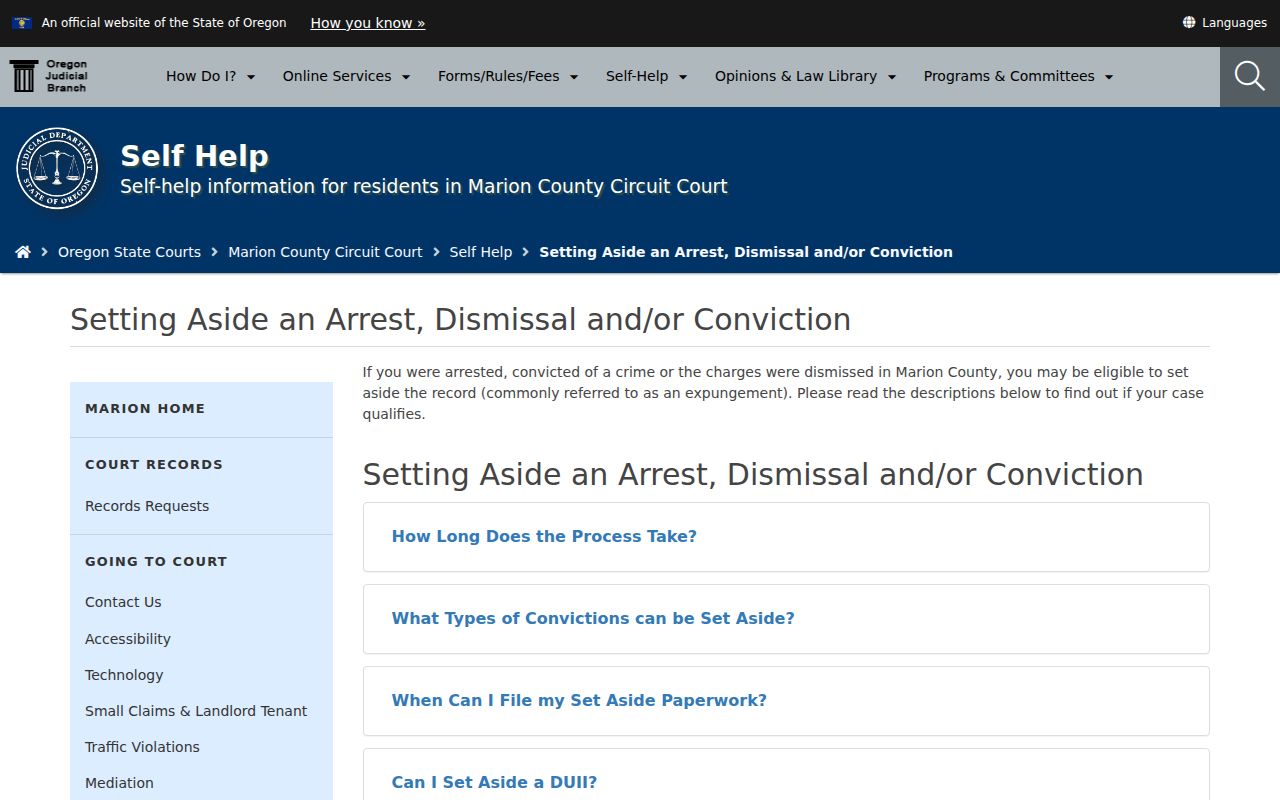
The process must be completed in the court of disposition before the record leaves ordinary public view.
The full Oregon criminal judgment and set-aside statute source supplies the controlling legal text.
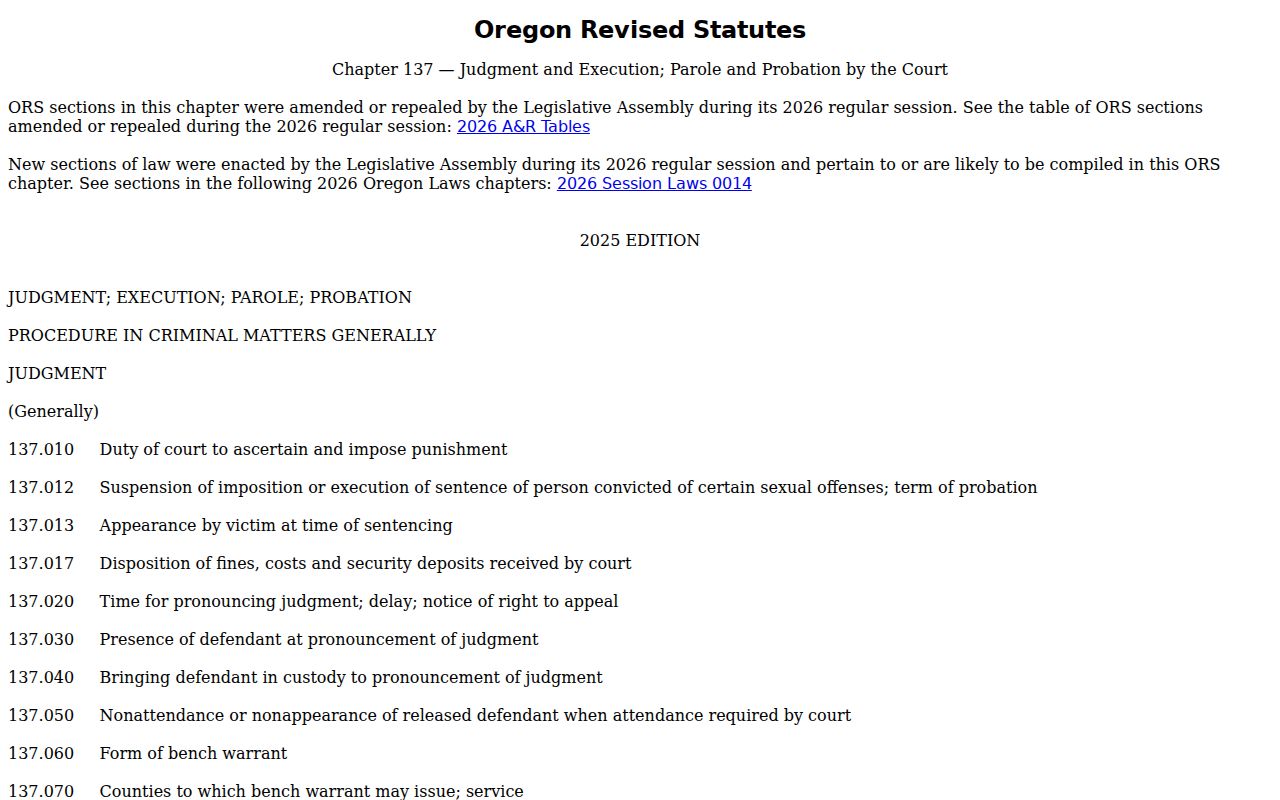
Current statutory eligibility should be checked before paying for fingerprints or filing a motion.
Oregon Criminal Records Access
Oregon case access rests on court-specific authority plus ORS 7.130 and 7.132, which address court records and protected personal information. The Oregon Public Records Law applies broadly to public bodies, while judicial access also follows court rules and inherent authority. Public access does not override juvenile, adoption, mental-health, protection, sealed, or protected-identifier limits.
Key Statutes:
ORS 7.130 and 7.132 require court records while protecting designated personal information.
ORS 419A.255 and 419A.262 create role-based juvenile access and a separate expunction process.
Oregon Statewide Criminal History
Oregon State Police CJIS maintains a different record. Its Open Record portal provides a name and description based Oregon-only report about another person. It includes Oregon convictions and arrests within the last calendar year when OSP has no acquittal or dismissal. Information older than one year is limited to convictions. The $33 fee is nonrefundable, the requester needs an account, and OSP notifies the subject. The statutory 14-day period cannot be waived.
The ORS chapter 181A criminal-history source explains Oregon disclosure authority.
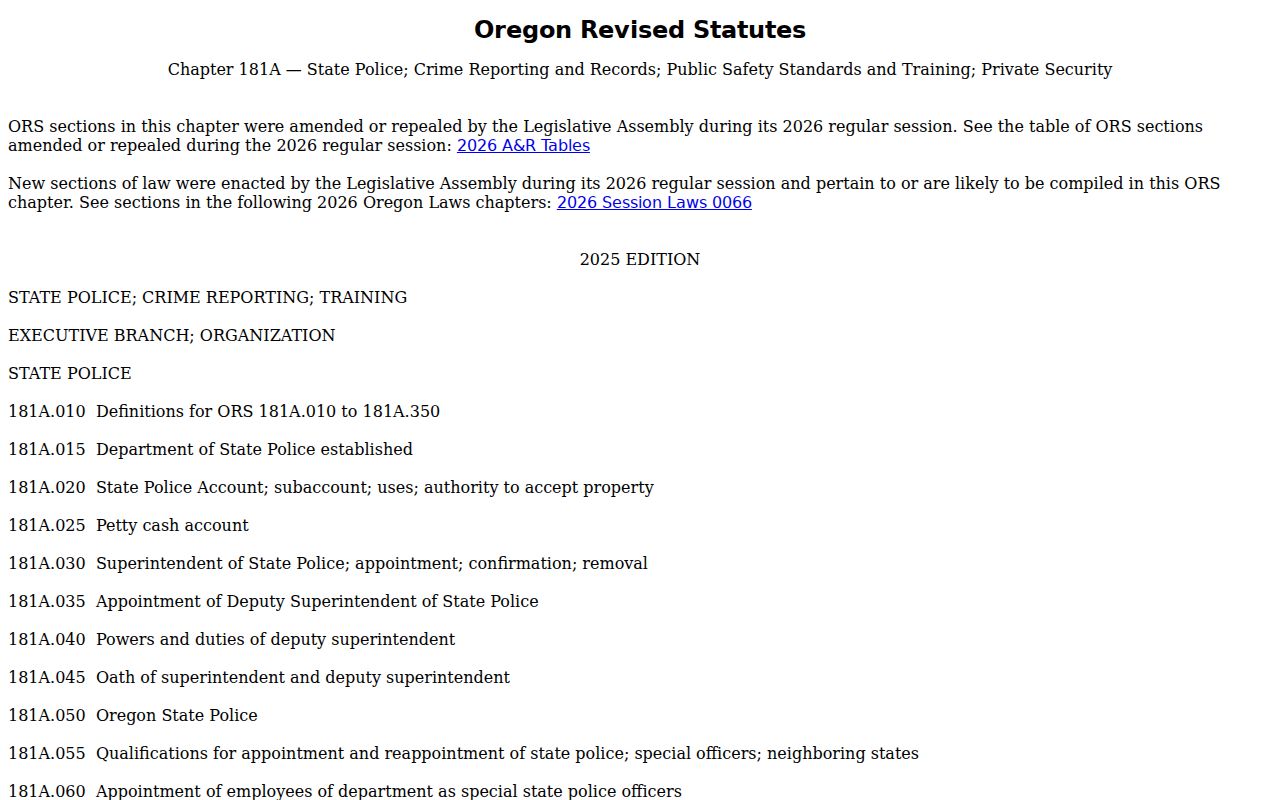
OSP history is a compiled repository result, while the filing court supplies the source complaint, register, and judgment.
A person requesting their own Oregon history uses the fingerprint-supported Copy of Own Record or Clearance Letter procedure, not the other-person portal. Formal consumer reports used for credit, work, tenancy, or insurance must comply with the Fair Credit Reporting Act. A casual OJD search is not an FCRA consumer report.
The other-person Open Record request asks for the subject's full name, aliases, date of birth, and current or last known address, plus requester identity and contact details. Mail requests use a separate OSP form. Own-record applicants can request a $33 record or clearance letter, with separate current charges for public fingerprinting and notary service when those options are needed.
Important: Records displayed here are not an FCRA consumer report and cannot be used for employment, credit, housing, or insurance decisions.
Restricted Oregon Criminal Records
Juvenile delinquency files are not ordinary public criminal cases. Sealed adult matters and qualifying set-aside records are absent from ordinary public portal and counter access. Courts also redact full birth dates, Social Security and account numbers, protected addresses, victim or minor information, and confidential sheets. Police and prosecutor files can withhold active-investigation, grand-jury, victim, work-product, medical, and other exempt material.
Use the filing court for the judicial record, OSP for the compiled statewide history, and the arresting agency for a releasable police or booking record. Never merge those sources as if they were one file. The source judgment and final count disposition are the best proof of how an Oregon criminal case ended.
Pending investigations, grand-jury material, prosecutor work product, victim information, and medical or security records can be withheld outside the case file. A defendant's discovery rights arise through criminal procedure and counsel, not from a generic public-record request. Public access and party access are not the same, and the court can require proof of identity or authority for restricted material.