
Search Oregon Court Records
Begin with the free OJD Records and Calendar Search. It covers Oregon circuit courts in all 36 counties, the Tax Court, Court of Appeals, and Supreme Court. It supplies basic case and calendar information without a login, but it does not display filed documents. The portal also omits adoption, juvenile, mental-health, sealed, VAWA-protected, and other restricted matters. Municipal and justice courts are locally funded and are not comprehensively indexed there.
Use the party's full name or exact OJD case number when possible. A filing location, case category, and date range can narrow common names. Current numbers often use a two-digit filing year, a two-letter category, and six digits, such as a CR criminal or VI violation number. Legacy and local court formats vary. If the issuing paper names a municipal or justice court, contact that clerk instead of assuming an OJD search will find it.
- Open the free OJD portal and choose Smart Search or the hearing search.
- Enter the exact case number, or search by party name and narrow the location.
- Read the case header, parties, public events, hearings, and disposition status.
- Use OJCIN OnLine or a free courthouse terminal for a fuller register and permitted document images.
- Order the exact public document from the filing court when an official or certified copy is required.
OJCIN subscribers use OECI for circuit and Tax Court records and ACMS for appellate records. Historical images depend on each court's Oregon eCourt start date. Older paper and microfilm files remain with the clerk. OJCIN information is close to real time, but the court states that the online service is not itself the official court record.
Oregon Court Record Search Fields
The free Oregon court records interface changes slightly by tab, but its core controls support a statewide name, number, location, category, or calendar search. Exact numbers yield the cleanest match. Date fields apply most directly to calendar searches, while the location filter includes every OJD circuit court and the three statewide court levels.
| Field Label | Type | Required | Notes / Format |
|---|---|---|---|
| Search Type | Tab or radio | Yes | Smart Search or Search Hearings |
| Search Criteria | Text | Yes | Party name or exact case number |
| Location | Dropdown | No | All locations, statewide courts, or one circuit county |
| Case Category or Type | Filter | No | Criminal, civil, family, probate, Tax, or appellate category |
| Date From and Date To | Date | Conditional | Use MM/DD/YYYY and a narrow calendar range |
| First and Last Name | Text | Conditional | Last name or business name is the key party field |
A name search can produce several people or businesses. Confirm the case caption, filing court, category, and dates before relying on a result. A case-number search avoids much of that ambiguity, but punctuation and legacy formats should be copied exactly. Hearing controls are useful for calendars, not proof that a scheduled event still will occur. The filing clerk should confirm any appearance before travel.
Types of Oregon Court Records
Oregon Circuit Courts have general trial jurisdiction. Their records span felony and misdemeanor cases, contract and tort suits, divorce and custody, probate and protective proceedings, small claims, evictions, protection orders, and state-law violations. The Oregon Tax Court maintains tax disputes. Appellate courts keep notices, briefs, motions, orders, opinions, judgments, and mandates. Justice courts may hear violations, misdemeanors, evictions, and civil or small claims through $10,000. Municipal courts commonly keep city ordinance, parking, traffic, and authorized misdemeanor files.
Record access follows the court that heard the matter. OJD circuit records go to the circuit clerk under the Trial Court Administrator. A city citation belongs with the municipal clerk, while a locally maintained justice case belongs with the justice court. The elected Oregon county clerk is generally the marriage, election, deed, and recording official. That office does not hold circuit criminal, civil, or divorce files merely because both offices may be in a courthouse.
- Civil: complaints, answers, motions, orders, judgments, and satisfaction records.
- Criminal: charging documents, pleas, motions, dispositions, judgments, and sentences.
- Family: dissolution, custody, support, parentage, and modification filings, with sensitive data restricted.
- Probate: estate, guardianship, conservatorship, and related trust-dispute records.
- Traffic and violations: citations, pleas, hearing events, fine judgments, and payment entries.
- Appellate: trial-record designations, briefs, argument information, opinions, judgments, and mandates.
Juvenile and civil commitment files exist within circuit court but do not follow ordinary public access rules. Adoption records are confidential. A blank online result may mean that the record is restricted, held by a local court, archived, or indexed under another name. It does not prove that no case exists.
What Oregon Court Records Show
An Oregon register of actions is the chronological log, not the full set of images. It can show accepted filings, hearings, notices, orders, judgments, reminders, and closure events. A line marked “filed” confirms clerk acceptance, not that a judge granted the request. Public views suppress protected addresses, full birth dates, Social Security numbers, account numbers, and other confidential data.
| Field | What It Shows |
|---|---|
| Case Number | Filing year, category code, sequence, and legacy formatting where applicable |
| Case Header | Filing court, category, date, status, and assigned judicial officer |
| Parties | Public names, roles, attorneys, and the State in criminal matters |
| Register Events | Filings, service, hearings, continuances, orders, trial, judgment, appeal, and mandate |
| Disposition | Outcome by claim or count, including dismissal, acquittal, conviction, or judgment |
| Financial Entries | Public fines, fees, restitution, payments, adjustments, plans, and satisfaction events |
| Documents | No images in free search; permitted images may appear through OECI or a terminal |
The official OJD court record request form can request circuit, Tax, and appellate documents or audio. A requester identifies the court, case number, case name, exact document title or hearing date, delivery method, and any certification. The court may take up to five court business days to respond and ten or more to complete a complex request. Failure to answer a follow-up within 60 court business days closes the request.
The OJD form and processing rules can be reviewed at the linked official source.
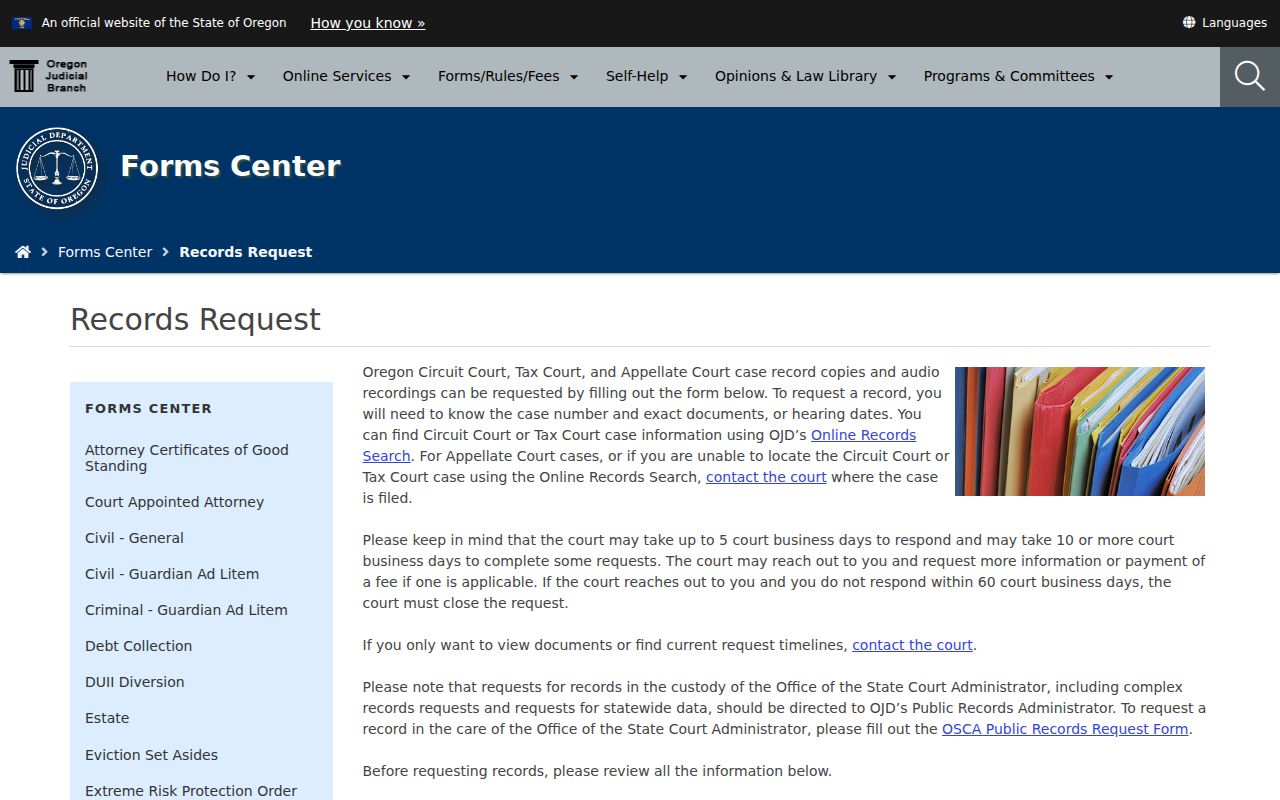
The form connects an online discovery search to a copy made by the Oregon court that holds the official file.
A regular copy reproduces the filed item. A certified copy adds the clerk's seal and statement that it is a true copy. Exemplification adds further clerk and judicial authentication for uses that require it. Audio is not a transcript. A transcript must be prepared through the applicable reporter or transcriber process and can carry separate charges.
Oregon Court Records Access Law
Oregon Public Records Law, ORS 192.311 through 192.478, governs public bodies in general. Judicial case access also follows court statutes, rules, and inherent judicial authority. ORS 7.130 and 7.132 address court records and protected personal information. State filing and confidentiality practice also follows the Oregon Rules of Civil Procedure and Uniform Trial Court Rules.
Ordinary public case discovery needs no special requester status. Access to a confidential case or protected document can require identity, party status, authorization, or a court order. Administrative records such as OJD policies, budgets, contracts, procurement, or custom statewide data go to the OSCA Public Records Administrator. That channel is separate from a case-copy request, and OJD need not create a new record merely to answer a question.
Typical court charges include $3 for an electronically delivered stored document request in a case, $3 plus $0.25 per page for a common paper copy, $5 plus page charges for certification, and $10 plus page charges for exemplification. Microfilm conversion is $0.45 per page. Electronic judicial audio is generally $9. The filing court's quote controls, and transcripts follow a separate process. OJD supplies an estimate when likely costs exceed $25 and may request advance payment.
Note: Free online case information is useful for discovery, but only the filing clerk can issue an official certified Oregon court record.
Restricted Oregon Court Records
Juvenile dependency and delinquency records have role-based access under ORS chapter 419A. Adoption files are confidential, and OJD uses a release-requirements process for those entitled to specified material. Civil commitment cases are excluded from free online search. Protection-order information covered by VAWA policy can also be suppressed from Internet display. Courts segregate protected identifiers even when the rest of a case remains public.
The official Oregon juvenile statutes show why a missing public result does not settle whether a file exists.
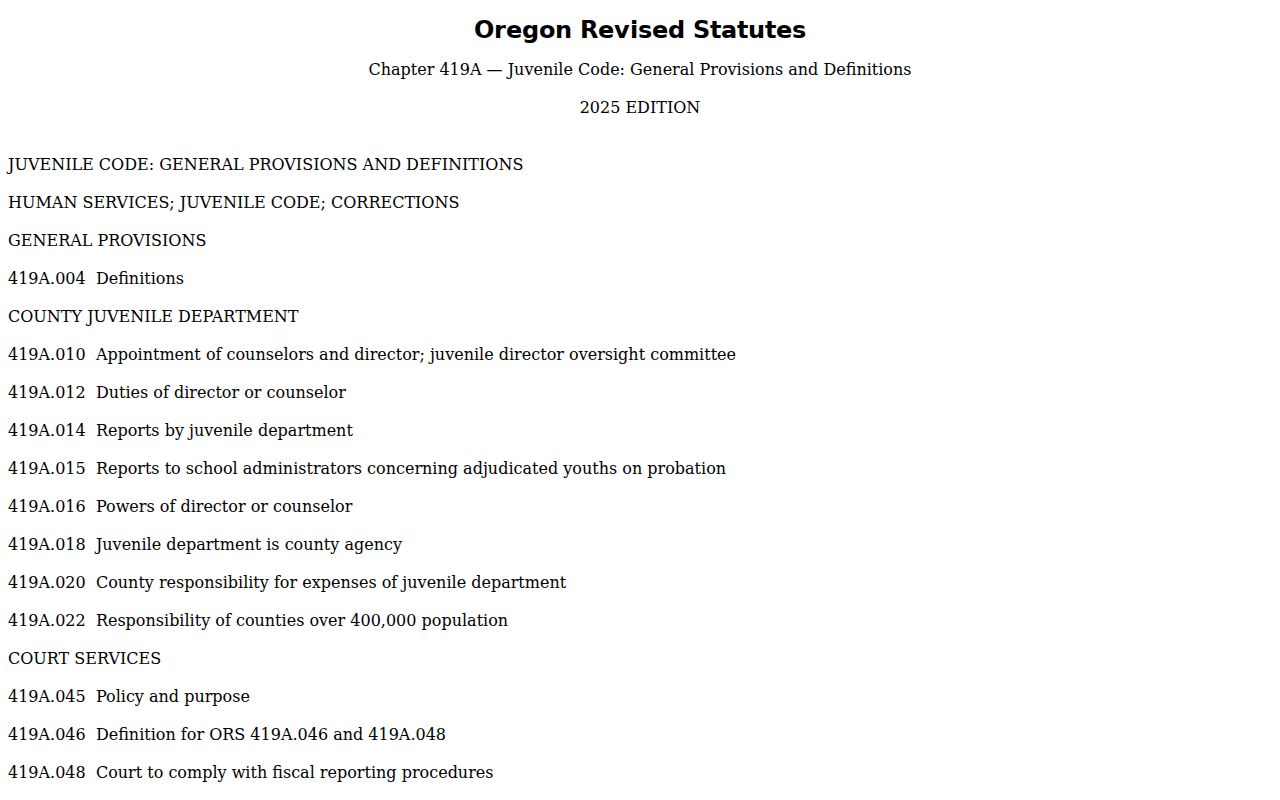
Authorized people should ask the filing circuit clerk which portion can be inspected and what proof of authority is required.
Eligible adult arrest and conviction records may be set aside under ORS 137.225. The motion goes to the court that handled the event. A signed order seals official court and investigative records from ordinary public access, subject to statutory exceptions. Oregon uses “expunction” chiefly for the separate juvenile process. Sealed content will not appear through ordinary portal or counter access.
Document-level redaction differs from sealing a whole case. A public family or civil docket may remain visible while confidential information forms, financial accounts, medical details, protected addresses, or sensitive child information stay unavailable. Parties and authorized counsel can have access rights that do not extend to the general public. The clerk can state what proof or court order is needed without giving legal advice.
Find an Oregon Court Office
Use the Oregon county directory to reach the circuit court for the filing county. Ask its OJD clerk for public terminals, older paper or microfilm, exact copies, audio, and local counter or mail instructions. The separately elected county clerk handles marriage and recorded instruments, not circuit cases. A municipal or justice matter must go to the local clerk named on the citation or case paper.
For opinions and selected federal or state docket material, the manifest-approved CourtListener source offers another research path.
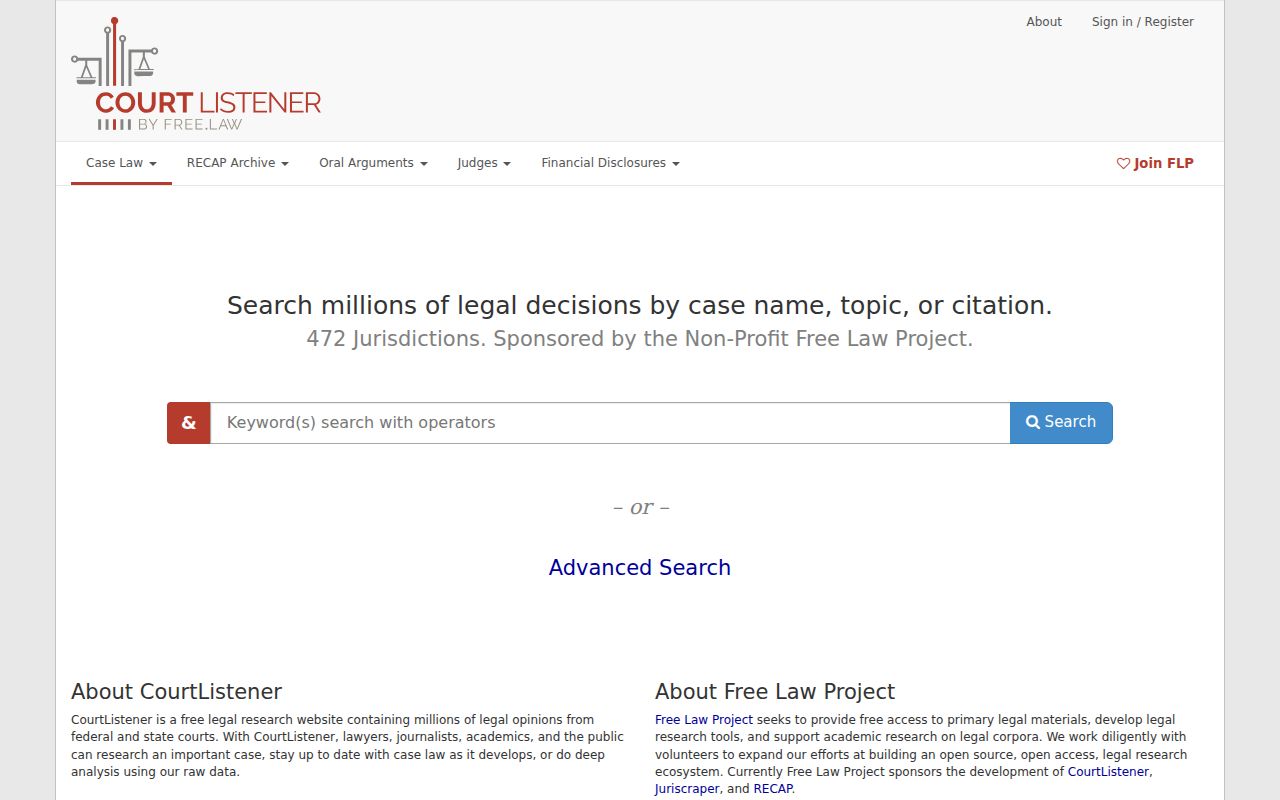
That research service does not replace an Oregon circuit clerk's certified copy or the official OJD register.
Tip: Match the filing court, not a party's current home county, before ordering Oregon court records or paying copy charges.