
How to Search Oregon Court Records
Most Oregon court record searches should begin with OJD Records and Calendar Search. The free service covers basic case and calendar information from all circuit courts, the Tax Court, Court of Appeals, and Supreme Court. It does not show filed document images. It also omits adoption, juvenile, mental-health, sealed, and other protected matters. Municipal and justice courts are outside this statewide OJD index, so the court named on a citation or complaint controls the route.
Use an exact case number when available. A name search works best with a location filter and enough identifying detail to separate people with similar names. Current OJD numbers often combine a two-digit filing year, a category such as CR, VI, or PB, and six digits. Older formats vary. The official OJD access overview confirms three paths: free search, paid OJCIN research, and direct clerk or courthouse-terminal access.
- Open the free statewide portal and select a case or hearing search.
- Enter the exact case number, or search the party name and narrow by court location.
- Read the case header, parties, status, register events, and public hearing details.
- Use OJCIN or a free circuit-court terminal when eligible documents or a fuller register are needed.
- Ask the filing clerk for exact documents, audio, older files, or a certified copy.
The official Oregon case-search screen shows the statewide public entry point.
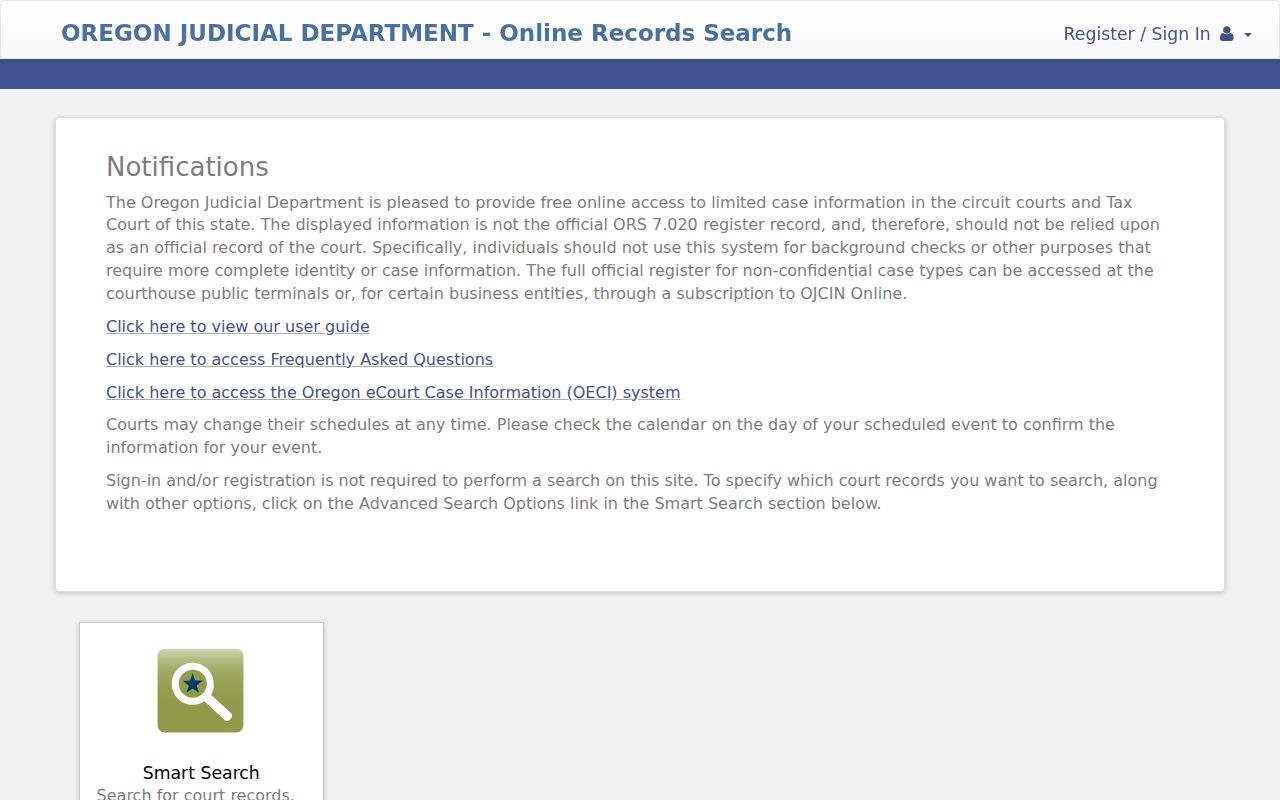
The result is an index and register view, not a certified copy of the court file.
| Search field | Use | Required |
|---|---|---|
| Search criteria | Case number or party name | Yes |
| Location | Statewide court or one circuit location | Optional |
| Case category | Criminal, civil, family, probate, or other indexed type | Optional |
| Date range | Narrows hearing-calendar results | Conditional |
Inside the Oregon Court System
The Oregon court system is unified for state courts. The Oregon Supreme Court is the single court of last resort. The Oregon Court of Appeals is one statewide intermediate court whose judges normally work in four panels, not geographic appellate districts. Oregon Circuit Courts are general-jurisdiction trial courts in every county and are grouped into 27 districts for administration. The specialized Oregon Tax Court has Magistrate and Regular Divisions.
Justice courts and municipal courts are the key local exception. They operate outside OJD and may hear traffic, parking, ordinance, violation, misdemeanor, eviction, and limited civil matters within their authority. Their cases may not appear in the statewide portal. The issuing court printed on the source paper is often the fastest clue.
Typical appeals path: Oregon Circuit Court › Oregon Court of Appeals › Oregon Supreme Court.
| Court | Role | Representative records |
|---|---|---|
| Oregon Supreme Court | Last resort and specified direct review | Petitions, briefs, orders, opinions |
| Oregon Court of Appeals | Most circuit appeals and agency review | Notices, briefs, opinions, mandates |
| Oregon Tax Court | State and local tax disputes | Complaints, decisions, judgments |
| Oregon Circuit Court | General trial jurisdiction | Criminal, civil, family, probate, juvenile |
| Justice or municipal court | Locally authorized limited jurisdiction | Citations, pleas, fines, warrants, judgments |
The OJD court directory displays all state circuit, appellate, and Tax Court destinations.
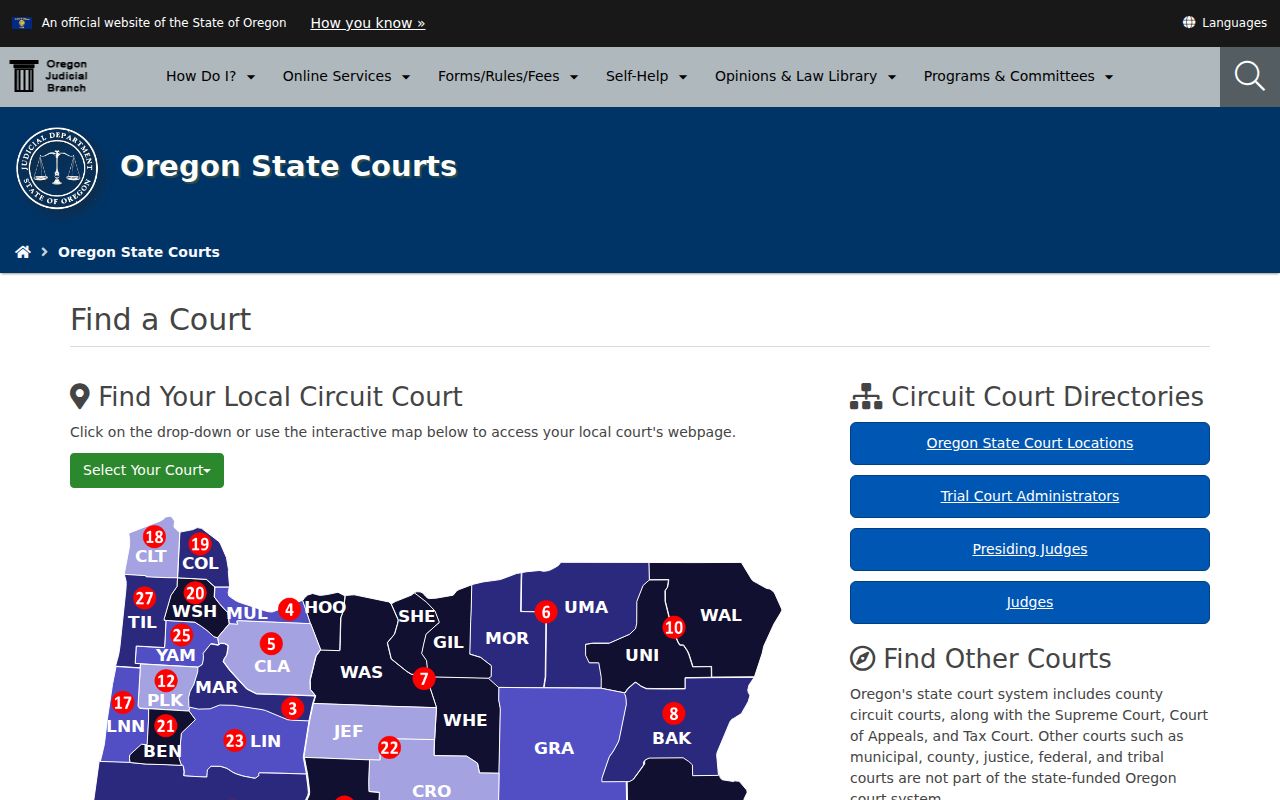
Local municipal and justice courts must still be found through the relevant county or city.
Types of Oregon Court Records
Oregon Circuit Court creates records across broad subject areas. Civil files can contain complaints, answers, motions, orders, judgments, and satisfaction entries. Criminal files begin when a complaint, information, or indictment is filed and then record pleas, hearings, dispositions, sentences, and appeals. Domestic-relations files cover dissolution, separation, custody, support, parentage, and later modifications. The public register may remain visible even when a sensitive attachment is restricted.
Probate files usually include a petition, will, appointment order, letters, notices, claims, accounting, and distribution judgment. Six counties may retain county-court probate jurisdiction unless transferred, so venue deserves a local check. Traffic records can sit in circuit, justice, or municipal court. Juvenile, adoption, and mental-health matters receive much tighter access. A private living trust is not automatically a court record merely because it exists.
- Criminal: filed accusations, count-by-count outcomes, judgment, and sentence.
- Civil: claims, responses, court orders, trial events, and judgments.
- Family: petitions, support and parenting documents, and general or supplemental judgments.
- Probate: estates, guardianships, conservatorships, and related fiduciary filings.
- Traffic: citations, pleas, hearing events, fines, defaults, and court dispositions.
What Oregon Case Records Show
An Oregon public result starts with the case number, caption, court location, category, filing date, and status. Party roles explain who brought or answered the matter. The register then lists dated events, such as a complaint, summons, proof of service, arraignment, plea, motion, hearing, order, judgment, appeal, or closure. A calendar entry may add the hearing type, time, assigned judicial officer, and courtroom when released.
Event text must be read with care. “Filed” means the clerk accepted a document; it does not mean the judge granted its request. A charge line is an accusation, while a disposition shows what happened to that count. Financial entries can reflect fines, restitution, fees, payments, or adjustments, yet the clerk's accounting remains authoritative. Free search does not display document images.
- Register of actions
- The chronological official log of case filings, hearings, orders, judgments, and reminders.
- Disposition
- The outcome of a charge or case, such as dismissed, acquitted, convicted, diverted, or judgment entered.
- Judgment
- The court decision that establishes relief, liability, conviction, sentence, or another enforceable result.
- Set aside
- Oregon's adult process under ORS 137.225 for sealing an eligible arrest or conviction record.
Oregon Free Search and OJCIN
The free portal is best for locating a case, checking a status, and reviewing basic events. OJCIN OnLine is the paid research layer. Its OECI component covers all 36 circuit courts plus Tax Court, while ACMS covers appellate records. Subscribers may see fuller registers, judgment dockets, and eligible document images. Availability for older images depends on when each circuit adopted Oregon eCourt.
A paid subscription is not the only public-access route. Every circuit courthouse provides a public OECI terminal. The clerk also handles older paper or microfilm, exact copy orders, and restricted-access review. OJD describes OJCIN information as near real time but not itself the official court record. A certified clerk copy is the better endpoint when proof matters.
The official OJCIN description sets out its OECI and ACMS coverage.
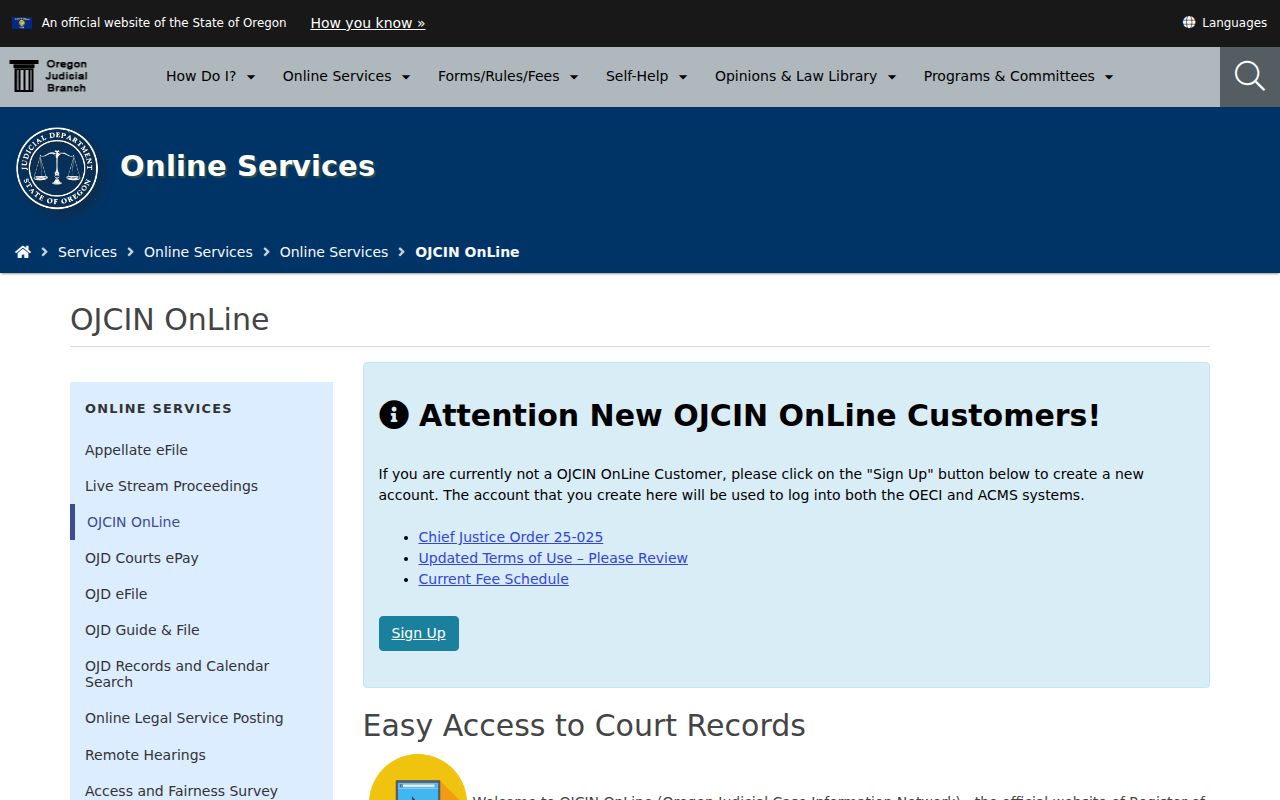
Historical document limits explain why a register can exist online while the underlying image still requires the filing clerk.
Note: A courthouse terminal can provide public OECI access without a personal OJCIN subscription, though copy and certification charges may still apply.
Statewide Oregon Record Systems
Several Oregon records do not belong in a court case database. The Oregon Department of Corrections Offender Search covers public information about adults in state custody or supervision, not county jail bookings. Oregon State Police operates the Open Record criminal-history service and the public sex-offender search. Oregon DMV provides protected driver-record products for the subject or another qualified requester. Oregon Vital Records issues eligible certified marriage and dissolution certificates, while the original marriage record and full divorce file remain with county and circuit custodians.
| System | What it holds | Custodian |
|---|---|---|
| Oregon Offender Search | State custody, location, SID, sentence and release data made public | Oregon DOC |
| OSP Open Record | Qualifying Oregon arrests and convictions under dissemination rules | Oregon State Police |
| Oregon DMV records | Product-specific driving history and license status | ODOT DMV |
| Oregon Vital Records | Eligible state-filed marriage and dissolution certificates | OHA Center for Health Statistics |
| OSP Sex Offender Search | Publicly disclosable registrant profiles, not every registrant | Oregon State Police |
Each system answers a different question. A jail booking does not prove that a prosecutor filed charges. A DOC profile does not replace the judgment. A DMV record shows driving consequences, not the complete citation file. When systems disagree, compare their dates and legal functions before treating either entry as wrong.
Oregon Court Records Access Law
Oregon case access draws from statutes, court rules, and the judiciary's authority over its records. Oregon Public Records Law generally governs records of public bodies, but a request under that law cannot compel a clerk to release a sealed case. For a filed case, the normal route is the OJD portal, OJCIN or a courthouse terminal, and then an exact request to the filing court. Administrative OJD records, such as budgets, contracts, policy, and aggregate data, use the OSCA public-record channel instead.
Key Oregon authorities:
ORS 192.311 through 192.478 governs access to nonexempt records held by Oregon public bodies.
ORS 7.130 and 7.132 address court records and protection of designated personal information.
ORS 137.225 creates Oregon's adult set-aside process for eligible arrests and convictions.
ORS 419A.255 and 419A.262 govern juvenile access and expunction.
Restricted Oregon Court Records
Adoption files are confidential, and access depends on the requester's identity, relationship, statutory route, or court order. Juvenile dependency and delinquency records use role-based rules rather than ordinary public-case assumptions. Mental-health cases are excluded from OJD's free online search. Federal and state protections also limit online publication of certain protection-order information. A blank name search therefore does not prove that no protected proceeding exists.
Oregon courts segregate full Social Security and account numbers, protected addresses, confidential information sheets, medical details, and specified information about minors. That can restrict one attachment while leaving a public register or order available. When an eligible adult record is set aside, the public portal and counter cannot disclose it through ordinary access. Juvenile expunction follows a different statute and process.
Note: Restricted access can depend on both the case category and the requester's legal role, so identification or a court order may be required.
Find Oregon Court Records by County
The filing county remains crucial even in a unified state system. It identifies the circuit clerk that can certify the case document and points to local courts omitted from OJD. The six largest Oregon counties below offer direct entry points. Each county site also distinguishes circuit records from sheriff bookings, elected county-clerk records, and local warrant or citation sources.
Multnomah County
Portland · Oregon's largest circuit docket and a dedicated OJD records workflow
Washington County
Hillsboro · major suburban civil, criminal, family, and traffic venue
Clackamas County
Oregon City · large circuit venue with separate city and local courts
Lane County
Eugene · major OJD circuit venue and federal court location
Marion County
Salem · state-capital circuit venue near statewide agencies
Jackson County
Medford · southern Oregon circuit and federal court location
Browse the full directory of all 36 Oregon counties to open the records site for any county.
Oregon Court Records Fees
Free OJD search and courthouse terminal inspection help locate a case before money is spent. Oregon court copy charges commonly include a $3 request charge plus $0.25 per paper page. Certification is $5 plus $0.25 per page, and exemplification is $10 plus $0.25 per page. Stored electronic documents are generally $3 per case request with no media charge when sent electronically. Microfilm conversion is $0.45 per page, and an electronic judicial recording is generally $9.
Those amounts do not cover every service. Filing, transcript, research, mailing, card, publication, sheriff, marriage-license, probate, and local-court costs can follow different schedules. OJD gives an estimate when a records request is likely to exceed $25 and may require approval or prepayment. A written waiver request can be considered, but public interest and ability to pay do not guarantee approval.
Read Oregon Court Records Carefully
Start with the court and case number, then read each event in date order. “Pending” is not a result. “Dismissed” is not a conviction. A guilty or no-contest plea and a guilty verdict can support conviction, while acquittal, diversion, and dismissal mean something else. Each criminal count can end differently. One dismissed count and one convicted count should never be compressed into a vague statement that the whole case was convicted.
Oregon uses “set aside” for the adult sealing process that many people call expungement. Juvenile law uses “expunction.” A “register of actions” is the event log, not the document images. A “filed” motion is merely received until an order decides it. Read related judgments, amended judgments, and appeal mandates before relying on an older event.
Oregon Record Limits and Corrections
Timing and scope explain many mismatches. OJCIN may update near real time, yet an older document image can remain unavailable because the circuit adopted eCourt later. A citation can take time to enter ePay. A jail roster may remove a person after release or transfer while the criminal case remains open. DOC dates can change after credit, resentencing, Board action, or recalculation. OSP applies its own disclosure rules to compiled history.
Correct the record at its source. A case caption or docket issue goes to the filing clerk. A booked allegation belongs with the sheriff or arresting agency until prosecutors and courts act. DOC corrects corrections data, DMV corrects driver data, and OHA corrects vital certificates under their own procedures. A public-record request to one agency cannot force another custodian to change its record.
Note: Confirm key facts with the filing clerk before relying on an Oregon portal result for a legal deadline or official proof.
History of Oregon Court Records
Oregon's judicial history predates statehood. Territorial settlers appointed Ira Babcock as the first “Supreme Judge” in 1841, and Oregon entered the Union in 1859. The Court of Appeals was created in 1969 to manage appellate workload. Modern unification gave the Chief Justice central administrative authority while municipal and justice courts stayed local. That split still defines record searching.
Oregon eCourt developed as an electronic courthouse. Legislative review began in 2007, financing followed in 2008, and circuit implementation expanded county by county during the next decade. OECI now covers all 36 circuit courts, but pre-conversion image access differs by county. The system is statewide without erasing the filing court's duty to maintain the official file.
Recent Oregon Court Access Changes
OJD continued both free Records and Calendar Search and paid OJCIN during 2025 and 2026, while publishing updated document-access information for older eCourt material. Its consolidated copy-request form states that a response may take up to five court business days and that complex completion can take ten or more. DOC separately moved many public-record requests into GovQA. These changes make statewide entry easier but do not replace local routing.
Oregon also updated ePay guidance to separate case-number and citation searches and to stress that paying an eligible open violation is a no-contest plea. Marriage law changed in 2025 to set the minimum age at 18. Local jail, municipal, justice-court, marriage-license, and older archive records still require the responsible county or city.
Oregon Court Records Questions
Can all Oregon cases be searched in one portal?
No. OJD's free portal covers Oregon state courts, including circuit, appellate, and Tax Court records that are public online. Municipal and justice courts are locally funded and can use separate systems. Protected case categories also do not appear in the free search.
Does a free result include filed documents?
No. It supplies basic case and calendar data. OJCIN or a courthouse terminal may show eligible images. Older paper or microfilm and certified copies require the filing clerk.
Are county clerks the circuit court clerks?
Not in Oregon. OJD employees under the Trial Court Administrator keep circuit case files. Elected county clerks generally handle marriage, election, recording, and other county functions.
Why is a known case missing?
Check spelling, venue, case number, local-court jurisdiction, date, and confidentiality. A city or justice case may sit outside OJD. Older files may be indexed but lack online images.
Where does an official copy come from?
The clerk of the court that filed the record issues regular, certified, or exemplified copies. Portal printouts are informational and may not satisfy a receiving agency's proof requirement.
Is Oregon criminal history the same as a court file?
No. Oregon State Police compiles qualifying statewide history under its disclosure rules. The circuit or local court file shows the charging documents, events, and judgment in one prosecution.